 kangshida
How the Contact Lens Market Has Evolved
For most of the last four decades, contact lenses were a prescription category. The product was bought from a clinical setting, the channel was controlled, and the consumer decision was driven by vision correction. Cosmetics existed as an edge case: tinted lenses for iris colour change were available, but they were marketed as an accessory rather than as a device.
That structure has changed. The category now contains two overlapping businesses — a vision-correction business that behaves like a healthcare market, and a cosmetic business that behaves like a fashion market — and the tension between those two behaviours is what most current trends trace back to.
The Shift From Cosmetic Accessory to Medical Device
The single most consequential change in the category is regulatory rather than commercial: cosmetic lenses have been reclassified as medical devices, and the effects are still working through distribution.
United States. The FDA is explicit that all contact lenses are medical devices, including decorative lenses sold for costume or cosmetic use, and that they require a prescription. Selling decorative lenses without a prescription is not a labelling technicality; it is the sale of an unapproved device.
European Union. Regulation (EU) 2017/745 introduced Annex XVI, covering products without an intended medical purpose, and that list includes non-corrective contact lenses. Common specifications are set out in Commission Implementing Regulation (EU) 2022/2346, and qualification and classification of these products is addressed in MDCG 2023-5, with equivalence addressed in MDCG 2023-6. The practical effect is that a purely decorative lens in the EU is now inside the medical device framework rather than outside it.
Three consequences follow for the market:
- Channel discipline. Unregulated novelty retail — costume shops, market stalls, unverified online sellers — is now non-compliant rather than merely unregulated, and enforcement activity is directed at it.
- Compliance cost becomes a market-entry barrier. Technical documentation, classification and conformity assessment cost money that a very small cosmetic brand may not be able to carry, which pushes consolidation toward larger players.
- Labelling and claims come under scrutiny. Once a product is a device, the claims made for it are part of its regulatory position, not only its marketing.
Regulatory Tightening Across Major Markets
The direction of travel is consistent even where the mechanisms differ: tighter control over who may sell, and what may be claimed.
- Prescription and verification. In the United States, contact lenses are prescription devices, and the FTC’s Contact Lens Rule under the Fairness to Contact Lens Consumers Act governs how prescriptions are released and how sellers must verify them before dispensing.
- Classification and conformity assessment. Under the MDR, the class of a lens and the resulting conformity assessment route determine how much technical evidence, clinical evaluation and post-market surveillance the product requires. Class determines cost.
- Post-market obligations. Post-market surveillance, vigilance reporting and Unique Device Identification are now continuous obligations rather than one-off approval tasks, which favours operators with a functioning quality system.
The commercial reading of this is straightforward: regulatory capability has become a competitive asset. Firms that treat it as overhead tend to lose access to markets rather than to save money.
Growth of the Colored Contact Lens Segment
Coloured lenses are the fastest-moving part of the category, and the reason is that they sell into two demand pools at once — the cosmetic demand for a changed appearance, and the vision-correction demand for a lens that happens to be tinted.
Third-party research on the segment gives an indication of scale, and it varies substantially by scope and methodology:
| Source | Scope as published | Figure |
|---|---|---|
| The Business Research Company, Coloured Contact Lenses Global Market Report | Coloured contact lenses | USD 4.66 billion, projected to reach USD 6.92 billion by 2030 at a 10.4% CAGR |
| Grand View Research, Soft Contact Lenses Market Report | Soft contact lenses (all types) | USD 9.8 billion in 2024, projected to grow from USD 11.3 billion in 2026 to USD 15.5 billion by 2030 |
| Grand View Research, Contact Lenses Market | Contact lenses, all types | Identifies the rising trend of cosmetic and coloured lenses as a significant market driver |
| GM Insights, Asia Pacific Contact Lenses Market | Asia-Pacific contact lenses | USD 4.81 billion in 2025, projected to USD 6.49 billion in 2034 at a 3.4% CAGR |
How to read these figures. They are third-party commercial estimates, not audited statistics, and they are not directly comparable: different reports define the category differently, cover different geographies and use different base years. The directional signal is the useful part — the cosmetic segment is a material growth driver and its share of the overall category is increasing. Any decision that depends on a specific number should confirm the scope of the underlying report rather than the headline.
Two structural features of the coloured segment are worth noting independently of the numbers. First, its demand is more seasonal and more trend-driven than the vision-correction segment, which makes inventory planning harder. Second, every coloured lens is also a vision-correction device or an Annex XVI device, so the segment carries the full compliance burden of a medical device while behaving commercially like apparel.
Online and Social Commerce Channels
Distribution has moved decisively online, and the shift has two faces.
Discovery has moved to social platforms. The decision to try a coloured lens is now often made on social media, in short-form video, and through regional beauty trends. This is a marketing channel that does not resemble a clinical setting at all, and it is why the category’s consumer-facing language sounds more like cosmetics than like healthcare.
Dispensing has not been deregulated. In markets with a prescription requirement, an online seller must still verify the prescription before dispensing, and jurisdictions have placed enforcement pressure on sellers that do not. Social discovery and regulatory compliance therefore sit at opposite ends of the same funnel, and brands that resolve that tension well are the ones that can scale.
Supply Chain and Manufacturing Trends
The production side of the category is capital-intensive and has been consolidating for some time.
- Process automation. Soft lens production is built around cast moulding and automated inspection. Scale advantages are real, which is why the number of independent high-volume producers is small relative to the number of brands on the market.
- Tooling as the gate on variety. Each distinct design and parameter combination requires its own tooling. A market that wants more colourways and more niche designs is asking for more tooling, which pushes variety decisions back toward consolidated production.
- Material supply. Siloxane-bearing monomers and other specialty inputs come from a limited supplier base, so material availability and cost can transmit directly into finished-lens economics.
- Sterile, wet logistics. Soft lenses ship wet and sterile in their final package. Packaging integrity, shelf life and cold-chain-free but sealed distribution are manufacturing constraints as much as logistics ones.
- The coloured segment adds decorative complexity. Printing adds process steps, and each colourway adds print set-up and inspection criteria on top of the ordinary lens process.
What “Medical-Grade Comfort” Means in Practice
The phrase appears frequently in product marketing, and it has no standardised technical definition. Understanding what it is usually trying to convey makes it easier to evaluate.
Comfort in a soft lens is usually attributed to a small set of measurable properties:
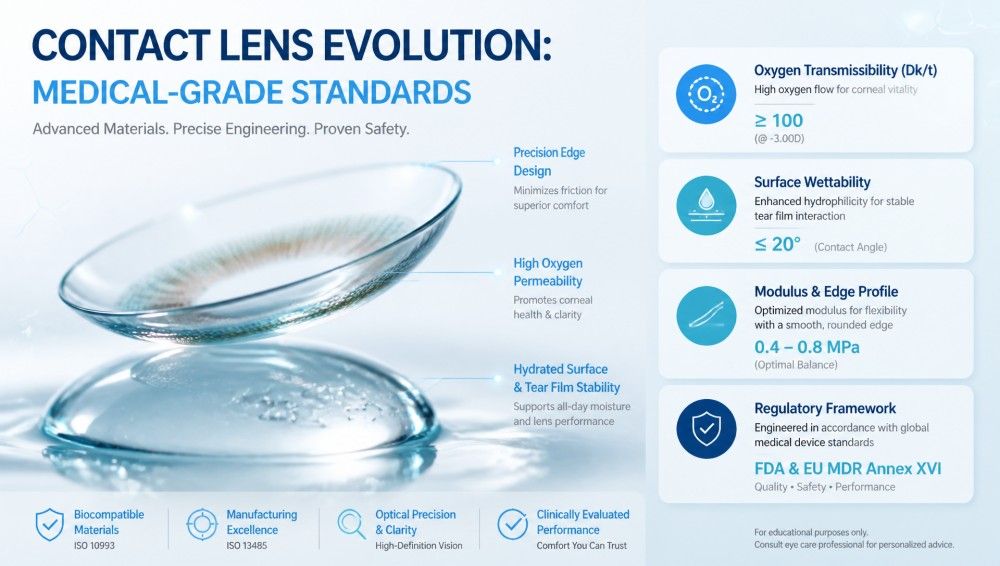
- Oxygen transmissibility (Dk/t) — how much oxygen reaches the cornea through that specific lens, which depends on material permeability and lens thickness.
- Surface wettability — how evenly the tear film covers the lens surface and how long it remains stable between blinks, influenced by surface treatment or internal wetting agents.
- Modulus — stiffness. A lower modulus generally drapes more readily; a higher modulus is often a consequence of the siloxane content that raises oxygen permeability.
- Edge and thickness profile — the geometry of the lens edge and the thickness at the periphery affect how the lid interacts with the lens.
- Fit — base curve and diameter relative to the individual cornea. A lens that fits poorly is uncomfortable regardless of its material.
So “medical-grade comfort” is most usefully read as shorthand for a claim about some combination of these properties — most often higher Dk/t and a wettable surface. It is verifiable only to the extent that the underlying parameters and their compliance status are documented. Where a product’s comfort claim is accompanied by certification and by published parameters, there is something to check. Where it is not, the phrase carries no technical content.
What to Watch Next
- Claim scrutiny. As more of the category sits inside medical device regulation, claims about health benefits — including those made for lens materials — are more likely to be examined as regulatory claims rather than advertising language.
- The compliance cost floor. The minimum cost of placing a lens on a regulated market acts as a filter. It favours models that carry several brands or markets over a single small brand.
- Segment convergence. The cosmetic and correction segments are converging in both directions: cosmetic-first brands are adding correction, and correction brands are adding cosmetic lines. The winners are likely to be those that can operate under clinical discipline while marketing at consumer speed.
- Packaging and waste. Single-use packaging is a growing share of the category’s material footprint and a growing point of consumer and regulatory attention.
- Regional variation. Asia-Pacific is consistently identified as a major growth region for contact lenses, and regional preference — colour, graphic diameter, replacement schedule — does not travel unchanged between markets.
FAQ
Are coloured contact lenses legal to sell without a prescription? In the United States they are medical devices and require a prescription, including decorative lenses. In the European Union, non-corrective lenses fall within Annex XVI of the MDR and are subject to the common specifications in Implementing Regulation (EU) 2022/2346. Requirements elsewhere vary, and national rules should be checked for each market.
Why do market size estimates for contact lenses differ so much? Because the reports define the category differently — coloured only, soft only, all contact lenses — and use different base years and geographies. The scope of the report matters more than the headline figure.
Is the coloured segment growing because of vision correction or because of cosmetics? Both. Tinted lenses serve wearers who want iris colour change and wearers who want a cosmetic effect on top of correction, and those two demand pools have different seasonality and different regulatory treatment in some markets.
What is the biggest regulatory difference between the EU and the US for cosmetic lenses? The framing. The US treats all contact lenses as medical devices requiring a prescription. The EU placed non-corrective lenses inside the MDR through Annex XVI with dedicated common specifications and classification guidance.
Does “medical-grade comfort” mean anything technical? Not as a standardised term. It usually points to higher oxygen transmissibility and better surface wettability, both of which can be documented. Without documented parameters it is a marketing phrase.
Are online sales of contact lenses allowed? Generally yes, but where a prescription is required the seller must verify it before dispensing, and enforcement action has been directed at sellers that do not.
What does consolidation mean for smaller brands? It shifts the structure of participation. Smaller brands increasingly operate on a manufacturer’s existing design platforms rather than commissioning independent development, because the fixed compliance and tooling costs are otherwise difficult to carry.
What should a buyer treat as the most reliable signal in this market? Regulatory status and documented device parameters. Market-share figures move quickly and vary by source; a device’s classification, certification and published specification do not.
Related Terms
Annex XVI · MDCG 2023-5 · MDCG 2023-6 · common specifications · conformity assessment · UDI · 510(k) premarket notification · Dk/t · wettability · cast moulding · private label · tooling
Sources and References
Regulation and official guidance
- Regulation (EU) 2017/745 on medical devices (MDR), Annex XVI — products without an intended medical purpose
- Commission Implementing Regulation (EU) 2022/2346 — common specifications for Annex XVI products
- MDCG 2023-5, Guidance on qualification and classification of Annex XVI products — https://health.ec.europa.eu/document/download/ea4acf26-979a-4dbb-92ff-8d1d804da51a_en?filename=mdcg_2023-5_en.pdf
- MDCG 2023-6, Guidance on demonstration of equivalence for Annex XVI products
- MDCG endorsed documents and other guidance, European Commission — https://health.ec.europa.eu/medical-devices-sector/new-regulations/guidance-mdcg-endorsed-documents-and-other-guidance_en
- US Food and Drug Administration, Decorative contact lenses — https://www.fda.gov/medical-devices/contact-lenses/decorative-contact-lenses-halloween-and-more
- US Food and Drug Administration, Contact lenses — https://www.fda.gov/medical-devices/consumer-products/contact-lenses
- US Federal Trade Commission, Contact Lens Rule (16 CFR Part 315), under the Fairness to Contact Lens Consumers Act of 2003
- US 21 CFR 886.5925 — Soft (hydrophilic) contact lens
Market data (third-party commercial estimates — see “How to read these figures” above)
- The Business Research Company, Coloured Contact Lenses Global Market Report — https://www.thebusinessresearchcompany.com/report/coloured-contact-lenses-global-market-report
- Grand View Research, Soft Contact Lenses Market Size & Share Report — https://www.grandviewresearch.com/industry-analysis/soft-contact-lenses-market-report
- Grand View Research, Contact Lenses Market Size, Growth Report — https://www.grandviewresearch.com/industry-analysis/contact-lenses-market
- GM Insights, Asia Pacific Contact Lenses Market Size Report — https://www.gminsights.com/industry-analysis/asia-pacific-contact-lenses-market
Standards (cited by designation; available from ISO and national standards bodies)
ISO 13485, Medical devices — Quality management systems — Requirements for regulatory purposes