
What “Disposable” Actually Describes
In contact lens terminology, the word disposable describes a planned replacement schedule rather than a single-use-only product. Almost every modern soft lens is replaced on a defined schedule, and “disposable” simply means the wearer discards the lens and starts a new one after that period, instead of cleaning and reusing one pair for as long as it holds up.
Two different variables are often confused, and separating them makes the rest of the topic much easier:
- Replacement frequency — how often a lens is discarded and replaced: daily, two-weekly, monthly, quarterly, or yearly.
- Wearing modality — how long a lens is worn before removal: daily wear (removed before sleep) or overnight/extended wear (worn during sleep).
These are independent. A monthly lens can be worn on a daily-wear basis or, where the labelling permits it, on an extended-wear basis. A daily disposable is worn once and discarded; it is not a lens that is “cleaned more often”.
Replacement Schedules Explained
| Schedule | Discarded after | Notes |
|---|---|---|
| Daily disposable | One wearing period | No cleaning or storage step. |
| Two-weekly | Up to 14 days of use | Cleaning and disinfection required; typically used on a daily-wear basis. |
| Monthly | Up to 30 days of use | The most widely used reusable schedule. |
| Quarterly | Up to 3 months of use | Less common in many markets; handling and care requirements are the same as monthly. |
| Yearly / annual | Up to 12 months of use | Still supplied in some markets, particularly in the coloured and cosmetic segment, where the lens is often worn intermittently. |
The category name describes a maximum, not a target. The clinical instruction is to replace on schedule regardless of how the lens feels, because deposit accumulation and surface degradation are not always perceptible to the wearer.
Material Differences: Hydrogel and Silicone Hydrogel
Soft lens materials divide into two broad families.
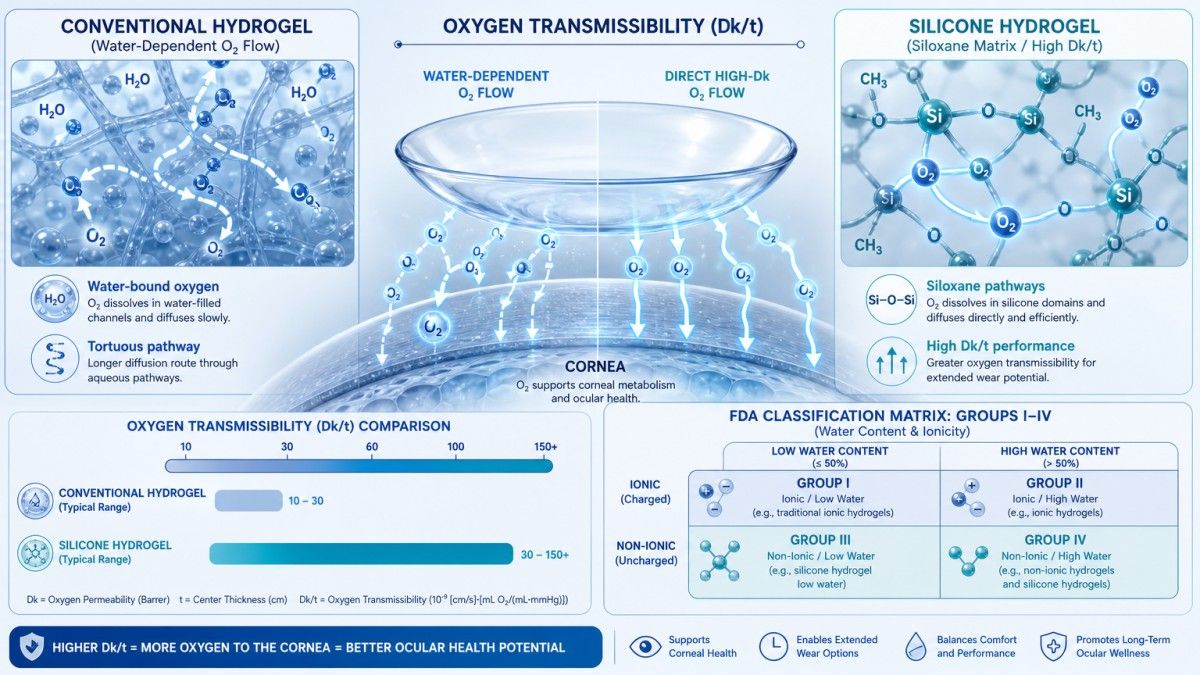
Conventional hydrogels are based on polymers such as poly(2-hydroxyethyl methacrylate), usually described as HEMA, and its copolymers. Oxygen reaches the cornea by dissolving in and diffusing through the water held inside the polymer network. Oxygen transmission is therefore tied to water content.
Silicone hydrogels add siloxane-bearing components — for example TRIS and methacrylate- or vinyl-terminated polydimethylsiloxanes — to the polymer. Here oxygen diffuses through the siloxane phase rather than the water, so high oxygen permeability can be achieved at moderate water content. These materials are generally stiffer, with a higher modulus, than conventional hydrogels.
Hydrogels are commonly described using a four-group system based on water content and ionicity, a classification that originates with the US Food and Drug Administration and is reflected in ISO 18369-1.
| Group | Water content | Ionicity |
|---|---|---|
| Group I | Below 50% | Non-ionic |
| Group II | Above 50% | Non-ionic |
| Group III | Below 50% | Ionic |
| Group IV | Above 50% | Ionic |
The grouping was devised for conventional hydrogels. Ionically charged materials tend to attract more protein deposits than non-ionic ones, which is the main reason the system remains useful when discussing deposit behaviour.
Water Content and Oxygen Permeability
Two numbers appear constantly in material descriptions, and they measure different things.
- Dk is the oxygen permeability of the material itself, conventionally expressed in Barrer units.
- Dk/t is the oxygen transmissibility of the finished lens: permeability divided by lens thickness. It describes how much oxygen actually reaches the cornea through a specific lens.
Because Dk/t depends on thickness, a thick lens in a highly permeable material can deliver less oxygen than a thin lens in a less permeable one. Comparisons built on Dk alone can therefore mislead.
Water content is often read as a quality signal, but the relationship is not linear. In a conventional hydrogel, more water generally means more oxygen transmission — and also a larger proportion of the lens that can lose water to evaporation between blinks, which is why high-water-content hydrogel lenses have historically been made thicker to manage dehydration. In a silicone hydrogel the water phase is not the oxygen pathway, so water content says very little about oxygen performance.
Deposit Build-Up and Comfort Over Time
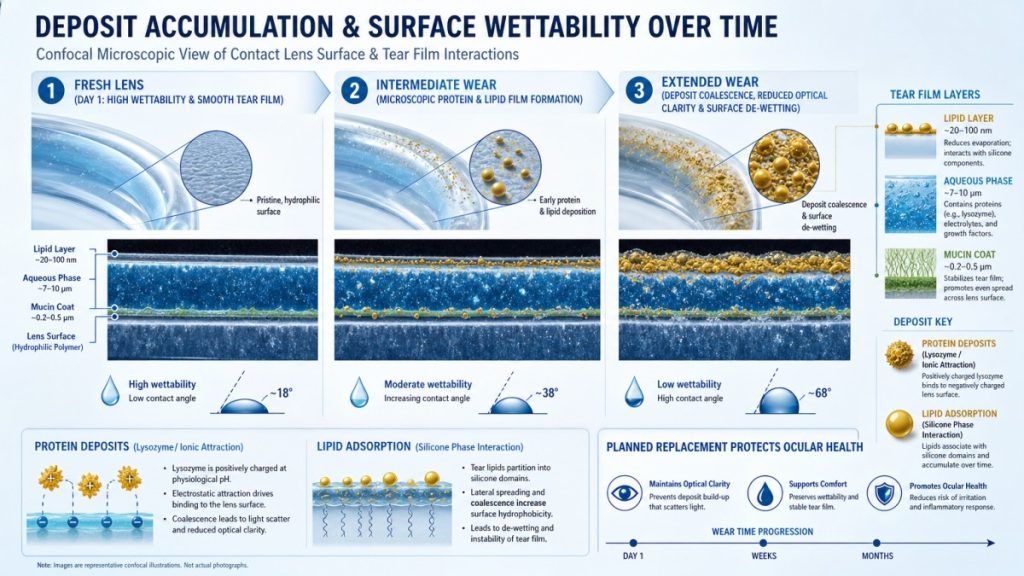
A worn lens accumulates material on and within it:
- Protein — lysozyme and other tear proteins, with ionic and high-water-content materials accumulating more.
- Lipid — more characteristic of silicone hydrogel materials, where the hydrophobic siloxane phase attracts tear lipids.
- Mucin, minerals and other tear components, which can combine with the above into a surface film.
Deposits matter for three reasons. They can reduce optical clarity, they can make the surface less wettable so that the tear film breaks up sooner between blinks, and they provide a substrate that interacts with the lens care system. Deposit accumulation is progressive, which is the underlying argument for frequent replacement: a lens replaced on schedule never has to perform while carrying the load of long-term use.
Why Replacement Frequency Affects Eye Health
The strongest and most consistent finding in the contact lens epidemiology literature concerns overnight wear. Wearing soft lenses during sleep is associated with a substantially higher risk of microbial keratitis than daily wear. Among daily-wear users, daily disposable lenses are consistently associated with the lowest complication rates of the available soft lens modalities, while reusable lenses carry a risk that scales with handling: contaminated cases, tap water contact, poor hand hygiene and infrequent case replacement are all established contributors.
That does not make reusable lenses unsafe. It means the risk profile of a reusable lens is partly a function of the wearer’s compliance with cleaning and storage, whereas a daily disposable removes that variable by design.
Two practical consequences follow:
- Replacement frequency is a hygiene variable, not only a convenience variable. A monthly lens worn for eight weeks has been handled and stored through roughly twice the number of care cycles.
- The care system is part of the lens. Multipurpose solutions and peroxide systems differ in how they clean and disinfect, and a lens material and a care product are not interchangeable combinations. The compatibility information that accompanies the product is specific to that pairing.
Cost Per Wear: A Neutral Comparison
Headline prices are a poor basis for comparing schedules, because the comparison has to include what the schedule requires. A neutral calculation looks like this:
cost per wearing day = (lens cost for the period
                        + care solution and case cost for the period
                        + professional care cost for the period)
                       ÷ number of wearing days in the period
Three points usually follow:
- Daily disposables concentrate all cost in the lens itself, with no care products, no case, and no replacement-of-case routine.
- Reusable lenses spread lens cost over more wearing days but add care products and require case replacement within the manufacturer’s stated interval.
- The result depends heavily on wearing frequency. For someone who wears lenses two days a week, the arithmetic of a yearly lens and that of a daily disposable converge; for daily wearers, the difference is wider.
Cost is also only one of several factors. Comfort over a full day, handling for people with reduced dexterity, and the wearer’s willingness to maintain a care routine all weigh in the same decision.

FAQ
Is a yearly lens simply a daily lens used for longer?
- No. The two are different products with different material choices, thickness profiles and surface specifications, and they are validated for different periods of use. A lens labelled for annual use is not interchangeable with a daily disposable.
Does a higher water content mean a more comfortable lens?
- Not on its own. Comfort depends on wettability, modulus, surface treatment, fit and the compatibility of the lens with the tear film. Water content is one input among several.
Are daily disposables the safest option?
- Published epidemiological work consistently associates daily disposable wear with the lowest complication rates among soft lens modalities, and overnight wear with the highest. No contact lens carries zero risk, and hygiene and fit remain decisive.
Can a reusable lens be worn overnight if it feels fine?
- Only where the labelling permits it. Overnight wear is a specific approval, not a matter of personal tolerance.
Why do my lenses feel less comfortable after a few weeks even when they look clean?
- Visible deposits are the last thing to appear. Protein and lipid films build up at a scale that is not visible to the eye, and surface wettability can change before the lens looks different.
Do silicone hydrogel lenses work with any multipurpose solution?
- Not necessarily. Compatibility is specific to the lens material and the solution, and the information supplied with the product is the reference.
Does a longer replacement cycle mean more care is needed?
- It means more care cycles, not more care per cycle. The routine is the same; it just has to be repeated far more often over the life of the lens.
What is the single most useful rule here?
- Follow the labelled replacement interval and the labelled wearing modality. Nearly every avoidable problem in the published literature traces back to one of those two being exceeded.
Related Terms
planned replacement · wearing modality (daily wear / extended wear) · Dk and Dk/t · water content · ionicity · FDA groups I–IV · modulus · protein and lipid deposits · multipurpose solution · hydrogen peroxide system · microbial keratitis
Sources and References
Standards (cited by designation; available from ISO and national standards bodies)
- ISO 18369-1, Ophthalmic optics — Contact lenses — Part 1: Vocabulary, classification system and recommendations for labelling specifications
- ISO 18369-2, Ophthalmic optics — Contact lenses — Part 2: Tolerances
- ISO 18369-4, Ophthalmic optics — Contact lenses — Part 4: Physicochemical properties of contact lens materials
- ISO 11978, Ophthalmic optics — Contact lenses and contact lens care products — Labelling
Regulatory references
- US 21 CFR 886.5925 — Soft (hydrophilic) contact lens
- Regulation (EU) 2017/745 on medical devices (MDR), Annex I — general safety and performance requirements, including labelling provisions relevant to replacement frequency and wearing modality
Agency information pages
- US Food and Drug Administration, Contact lenses — https://www.fda.gov/medical-devices/consumer-products/contact-lenses
- US Food and Drug Administration, Buying contact lenses — https://www.fda.gov/medical-devices/contact-lenses/buying-contact-lenses