 kangshida
What Pigment Encapsulation Means
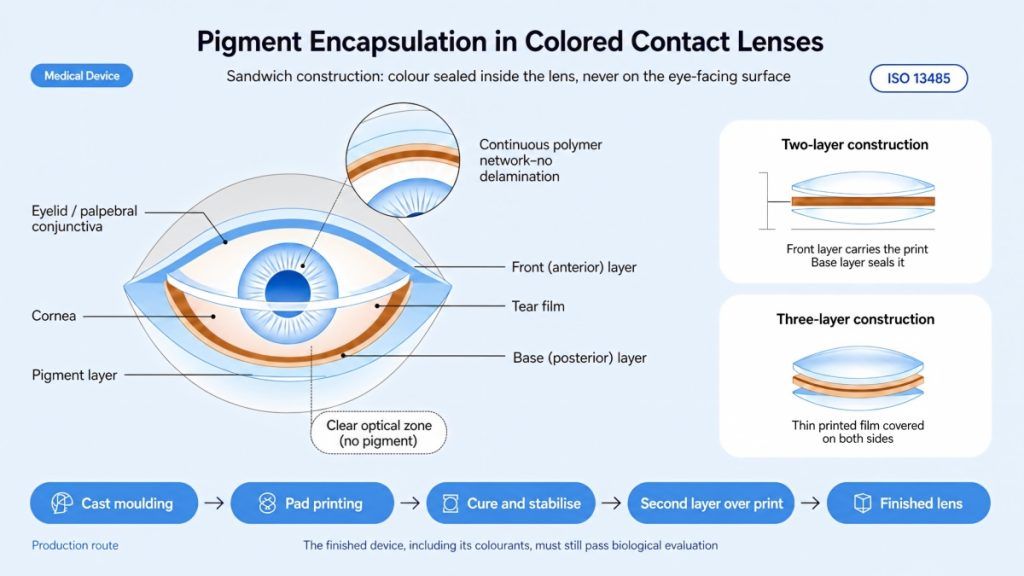
Coloured soft contact lenses are not made by dyeing plastic. The iris pattern is produced by printing colorant onto a lens layer and then closing the lens structure over it, so that the colorant ends up inside the material rather than on the surface that touches the eye. That construction is what the industry calls an encapsulated, or sandwich, pigment layer.
The term matters because it describes a physical fact about where the colour sits, and that fact has consequences for how the lens behaves against the eyelid and the tear film. The colour is not merely “medical grade”; it is positioned so that the ocular surface never comes into direct contact with the printed ink.
Why Encapsulation Matters for Eye Safety
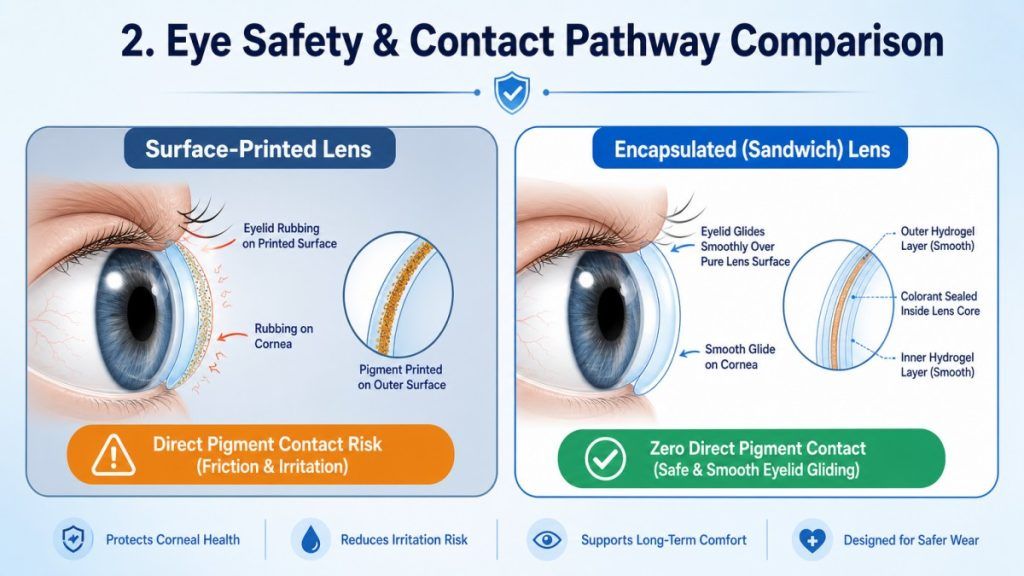
The outer surface of a soft lens is in continuous contact with two delicate structures: the palpebral conjunctiva — the inner surface of the eyelids — and the corneal and conjunctival epithelium, through the tear film. Both are mucosal-type tissues with a low tolerance for particulates and irritants. Any substance present on the outer lens surface is therefore continuously exposed to tissue and continuously subject to being shed into the tear film.
Encapsulation changes that exposure pathway in three ways:
- No direct pigment-to-tissue contact. The colourant is not part of the outermost surface, so the eyelid slides over lens material rather than over printed ink.
- Reduced potential for pigment loss. A colourant that is sealed within the lens structure is not exposed to tear-film flow, lid movement or the mechanical action of lens handling in the same way as a surface layer.
- A defined separation between the optical surface and the decorative layer. The clear optical zone and the lens surface can be finished to their own specification without the colourant being part of that surface.
An important qualification: encapsulation reduces one exposure pathway. It does not replace biological evaluation. A coloured contact lens — whatever its construction — is a medical device, and the finished device, including its colourants, must be assessed for biocompatibility and for the extractable and leachable substances that could reach the eye over the intended wearing period.
How Sandwich Construction Works
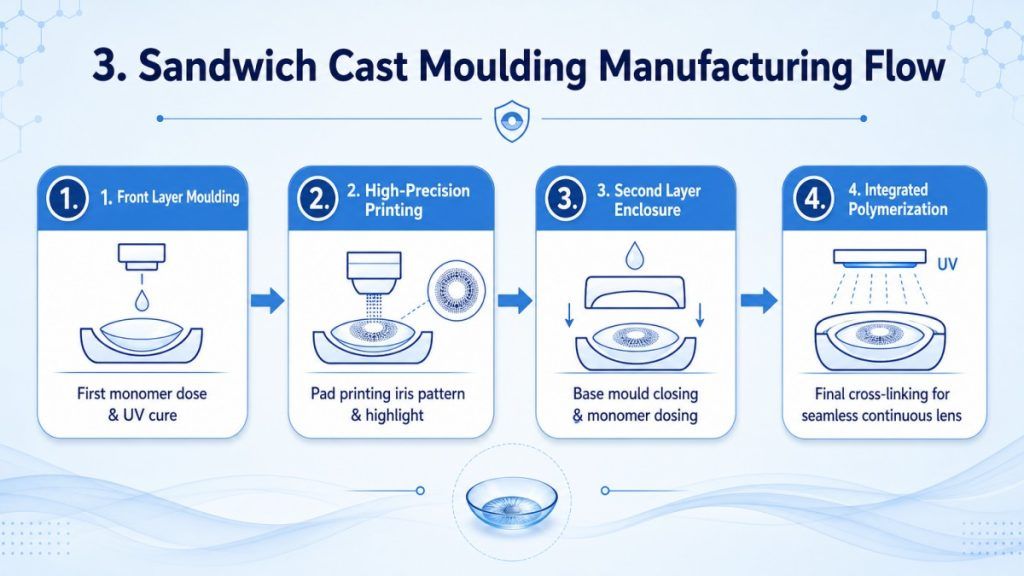
The dominant production route for soft contact lenses is cast moulding: liquid monomer mixture is dosed into a mould cavity and cured — usually with ultraviolet light or heat — into the final lens shape. Sandwich pigment construction adds printed steps to that sequence.
A two-layer construction typically works like this:
- The first lens layer is formed and cured on the front-curve mould.
- The iris pattern is printed onto that layer, normally by pad printing (tampography), which transfers ink from an engraved plate through a soft pad. Multiple passes may be used to build up tone and blending.
- The ink is cured or dried and stabilised.
- The second layer is formed over the printed pattern — for example by dosing further monomer and closing with the base-curve mould — and cured, so the printed pattern is enclosed between two layers of lens material.
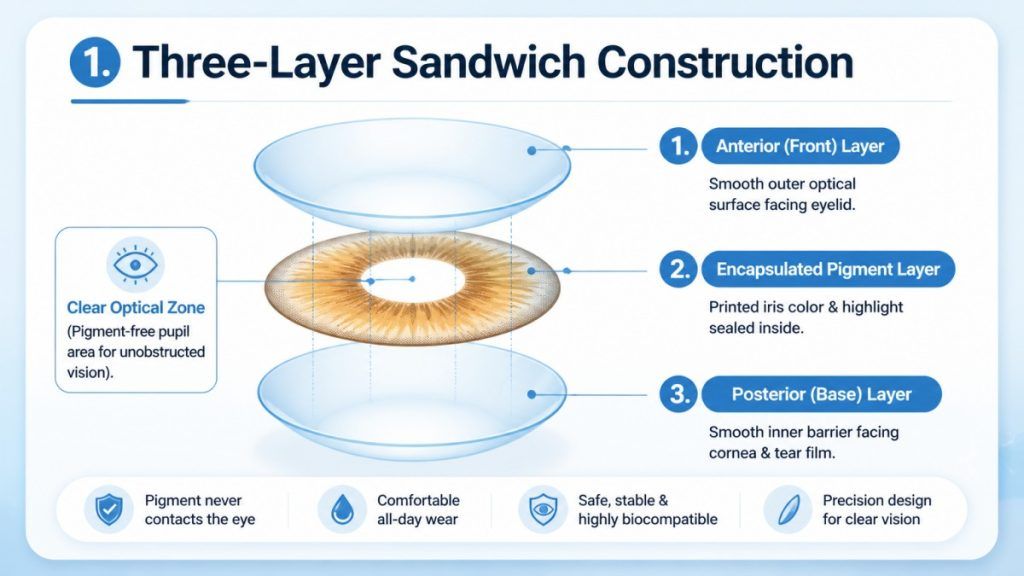
A three-layer construction uses a thin central film carrying the print, which is then covered on both sides. Both approaches achieve the same objective: the colourant is held inside the lens rather than exposed on it.
Layer Structure Explained
Reading a construction diagram, four elements usually appear:
- Front (anterior) layer — the layer that faces outwards. It defines the outer optical surface and carries the print in a two-layer build.
- Pigment layer — the printed pattern. Its thickness is small relative to the lens, but it is the layer that determines colour, blending, graphic diameter and any highlight element.
- Base (posterior) layer — the layer that faces the eye. It forms the inner optical surface and, in an encapsulated build, the barrier between the colourant and the ocular surface.
- Clear optical zone — the central area that must remain free of pigment so that light is focused without interference.
Adjacent layers are not glued together as separate components. They are formed so that the polymer network is continuous or bonded across the interface, which is why delamination between layers is a process risk rather than an inevitable consequence of the design.
Manufacturing Considerations
Controlled environment. Soft lens production is carried out in controlled-environment areas, with classification and monitoring matched to the process step: monomer handling, moulding and curing, printing, packaging and sterilization have different cleanliness requirements. Particulate and microbial monitoring is part of routine production control.
Water quality. Lens material and packaging solutions depend on water of defined purity. Because soft lenses are largely water, contamination introduced through process water reaches the finished product directly.
Ink and colourant control. Printing inks and colourants intended for a device that contacts the eye are treated as controlled raw materials, with batch documentation, identity testing and change control. A change in ink supplier or formulation is a change to the device.
Curing and bonding. Layer bonding depends on cure chemistry, timing and monomer dose. Under-cured material can leave residual reactive species; over-cured or poorly bonded layers can create weak interfaces.
Sterilization and packaging. Soft contact lenses are normally sterilized in their final sealed package. Because the product is supplied wet, package integrity and the sterility assurance level are established through validated processes, and shelf life is justified by stability data.
Design and process interact. The printed graphic adds material and can affect local thickness, and the encapsulation build adds process steps relative to a single-layer lens. Design decisions — how many print passes, how much opacity, how fine the print detail — set the process complexity and therefore the cost and yield profile.
Quality Control and Inspection Points
A layered pigment construction creates specific control points in addition to the general ones that apply to any soft lens.
Incoming material control. Identity, grade and batch certification of colourants and inks; verification that no unapproved substitute enters production.
Print registration and centration. The printed iris pattern and any highlight must sit in the intended position relative to the lens centre and the optical zone. Off-centre registration is a cosmetic defect that inspection must be able to detect reliably.
Optical zone clearance. Verification that the central optical zone is free of pigment, and that the graphic diameter matches specification.
Layer bonding and delamination resistance. Bonding is assessed through process validation and periodic testing, including exposure to hydration, storage and mechanical handling.
Pigment migration and colour fastness. Testing establishes whether colourant or ink constituents can migrate out of the lens structure under conditions relevant to use and storage, including extraction studies that feed the biological evaluation.
Dimensional and optical parameters. Geometry, thickness and optical power are verified against the tolerances and measurement methods defined in the ISO 18369 series.
Cosmetic inspection. Visual inspection at magnification for print defects, colour inconsistencies, edge defects and particulate inclusion, with defined accept and reject criteria.
Package integrity and sterility. Leak testing, seal integrity and sterilization validation, together with batch traceability that links a released lot back to its materials and process records.
Common Misconceptions
“Sandwich construction means three separate lenses joined together.” It does not. The layers are formed as part of one continuous production sequence and become one lens.
“If the pigment is inside the lens, no safety testing is needed.” The opposite is true. Colourants and inks are part of the device and are covered by the biological evaluation of the finished product.
“Pigment can leak into the eye if the lens is worn long enough.” Migration testing exists precisely to establish whether constituents can leave the lens structure under use conditions. A lens that is torn, cut or otherwise damaged is not a valid comparison: a damaged lens should be discarded.
“Colour is always printed on the outside of a lens, just sealed in.” Several colouring routes exist, including tinted materials and surface-printed designs. The construction determines the exposure pathway, and the regulatory requirement to demonstrate safety applies to all of them.
“An encapsulated lens is necessarily thicker and less comfortable.” The pigment layer is thin relative to the lens, but print passes and layer build do add material. Whether this is perceptible depends on the overall design, not on the presence of encapsulation alone.
“Encapsulated means hypoallergenic.” There is no standardised meaning for that term in this context. Tolerance depends on the material, the fit, the care regime and the individual wearer.
FAQ
What is the difference between surface-printed and encapsulated colour? In surface-printed designs the colourant is on the outer lens surface, where it is exposed to the eyelid and the tear film. In encapsulated designs the colourant is held within the lens structure, between layers. Both approaches are used commercially and both must meet the same regulatory requirement to demonstrate safety.
Does encapsulation affect oxygen transmission? Any added material affects local thickness and therefore local oxygen transmissibility. The pigment layer is thin compared with the lens body, and the finished lens is characterised by its measured Dk/t rather than by the construction method.
Can the printed pattern be felt by the wearer? In an encapsulated build the pattern is covered by lens material, so the surface the eyelid contacts is lens material rather than print.
Why does print registration matter so much? Because the pupil and the limbal boundary give the eye an obvious reference. A printed pattern that is visibly off-centre relative to those references is read as a defect even when it is optically harmless.
Is the colour always on the front layer? Printing position varies with the construction. The requirement is that the colourant ends up enclosed, and that the layer facing the eye presents lens material rather than ink.
How is pigment position checked in production? Through in-line or batch inspection at magnification against defined accept and reject criteria, supported by process validation that demonstrates the printing step holds its registration over time.
Does colour fastness matter for a lens that is replaced daily? It still matters. Migration and extraction testing is based on the intended contact with the eye over the intended wearing period, and short replacement does not remove the requirement.
Who sets these requirements? Regulatory frameworks set the requirement, and the ISO 18369 series together with the ISO 10993 series provide the recognised measurement, labelling and biological evaluation methods. Designers and manufacturers apply them, and notified bodies or regulators assess the result.
Related Terms
pigment encapsulation · pad printing (tampography) · cast moulding · graphic diameter · optical zone · extractables and leachables · biological evaluation · delamination · sterility assurance level · shelf life
Sources and References
Standards (cited by designation; available from ISO and national standards bodies)
- ISO 18369-1, Ophthalmic optics — Contact lenses — Part 1: Vocabulary, classification system and recommendations for labelling specifications
- ISO 18369-2, Ophthalmic optics — Contact lenses — Part 2: Tolerances
- ISO 18369-3, Ophthalmic optics — Contact lenses — Part 3: Measurement methods
- ISO 18369-4, Ophthalmic optics — Contact lenses — Part 4: Physicochemical properties of contact lens materials
- ISO 11978, Ophthalmic optics — Contact lenses and contact lens care products — Labelling
- ISO 10993-1, Biological evaluation of medical devices — Part 1: Evaluation and testing within a risk management process
Regulatory references
- Regulation (EU) 2017/745 on medical devices (MDR), Annex I — general safety and performance requirements
- US 21 CFR 886.5925 — Soft (hydrophilic) contact lens, and 21 CFR 886.5916 — Rigid gas permeable contact lens
Agency information pages
- US Food and Drug Administration, Contact lenses — https://www.fda.gov/medical-devices/consumer-products/contact-lenses
- US Food and Drug Administration, Decorative contact lenses — https://www.fda.gov/medical-devices/contact-lenses/decorative-contact-lenses-halloween-and-more
- US Food and Drug Administration, List of contact lenses allowed to be sold in the United States — https://www.fda.gov/medical-devices/contact-lenses/list-contact-lenses