 kangshida
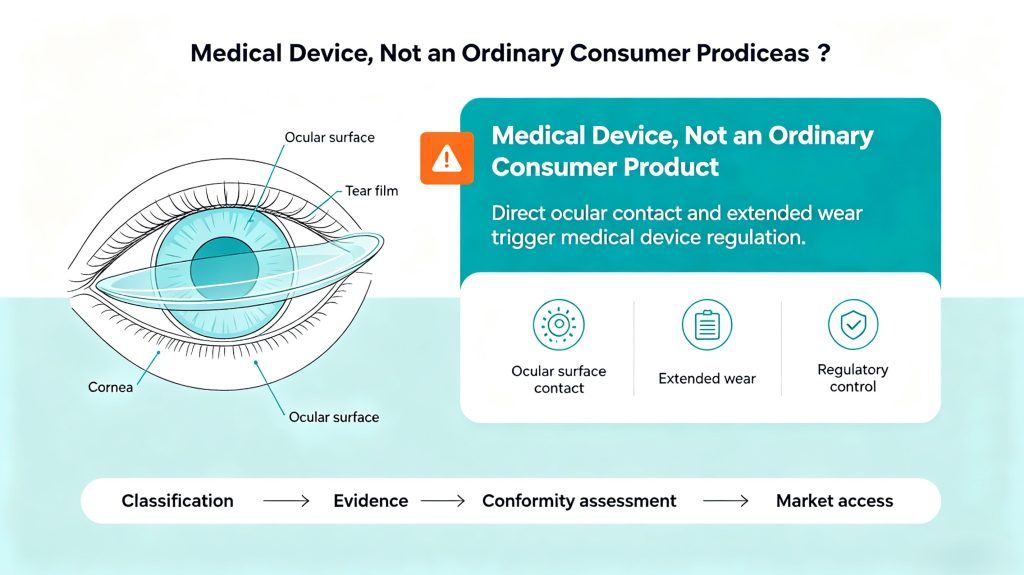
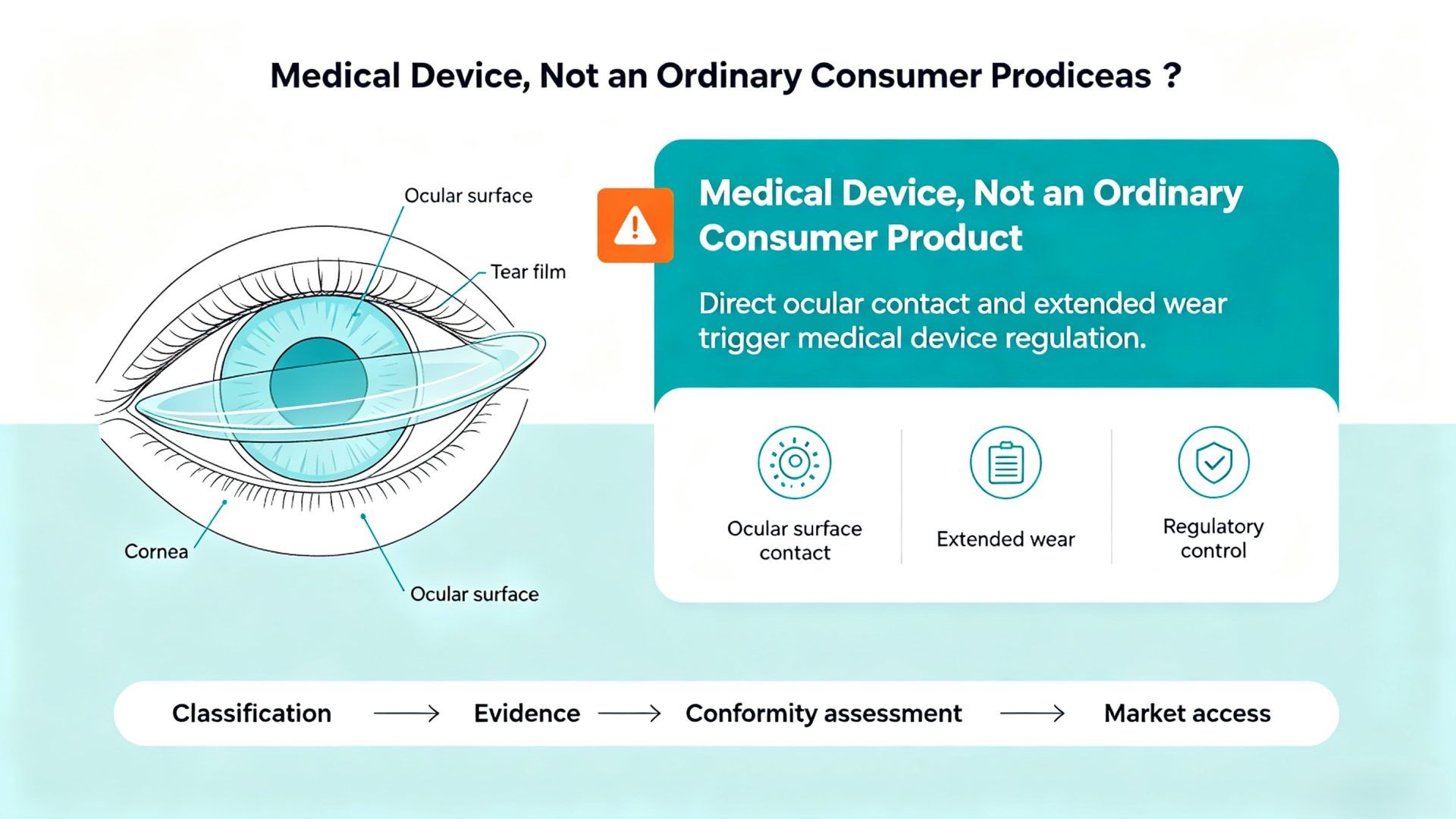
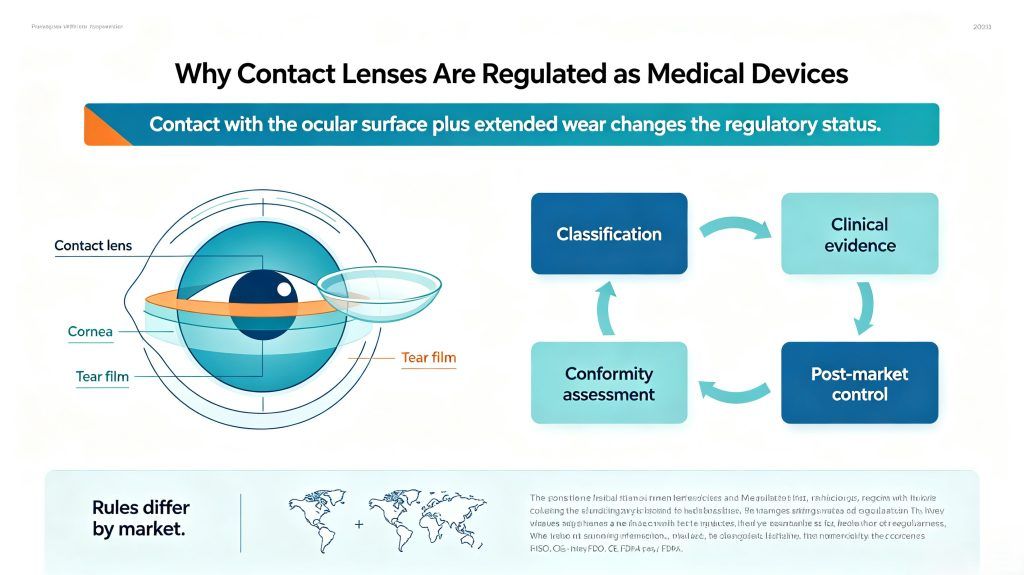
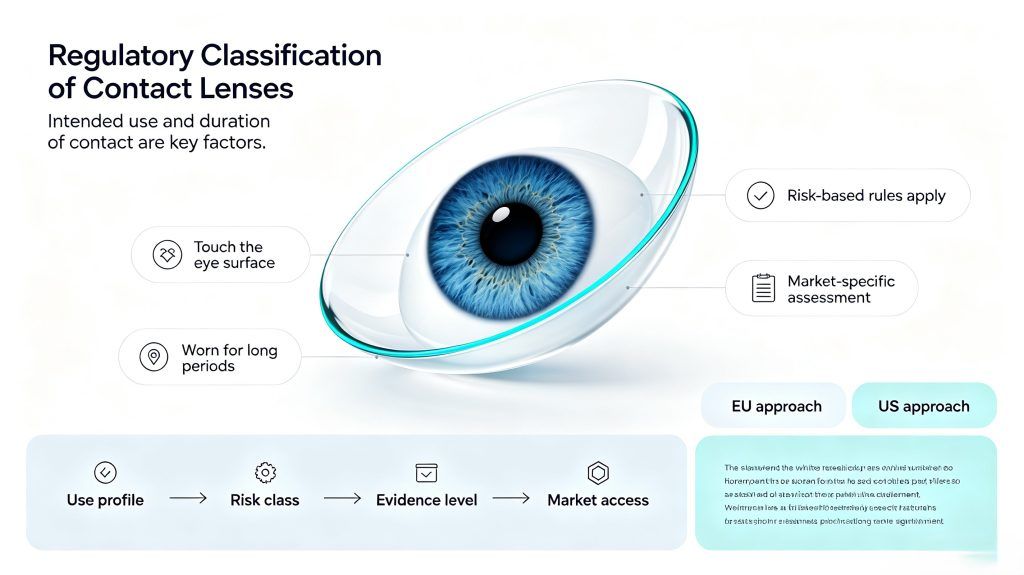
Contact lenses rest directly on the surface of the eye. They interact with the cornea, the tear film and the ocular surface, and they are worn for extended periods. For that reason, regulators in most major markets treat contact lenses as medical devices rather than as ordinary consumer products.
That classification has practical consequences. It determines which premarket evidence a manufacturer must produce, whether an independent body has to review the product, what must appear on the label, and what obligations continue after the product is on the market.
Two frameworks illustrate how this works in practice: the European Union’s Medical Device Regulation and the United States system administered by the Food and Drug Administration.
The EU Framework: Regulation (EU) 2017/745
In the EU, medical devices are governed by Regulation (EU) 2017/745, commonly called the Medical Device Regulation or MDR. The MDR replaced the older Medical Devices Directive and applies a risk-based classification system set out in Annex VIII.
Annex VIII contains 22 classification rules, organised in groups:
- Rules 1–4 cover non-invasive devices
- Rules 5–8 cover invasive devices
- Further rules address active devices, special cases and additional risk factors
How the MDR Classifies Contact Lenses
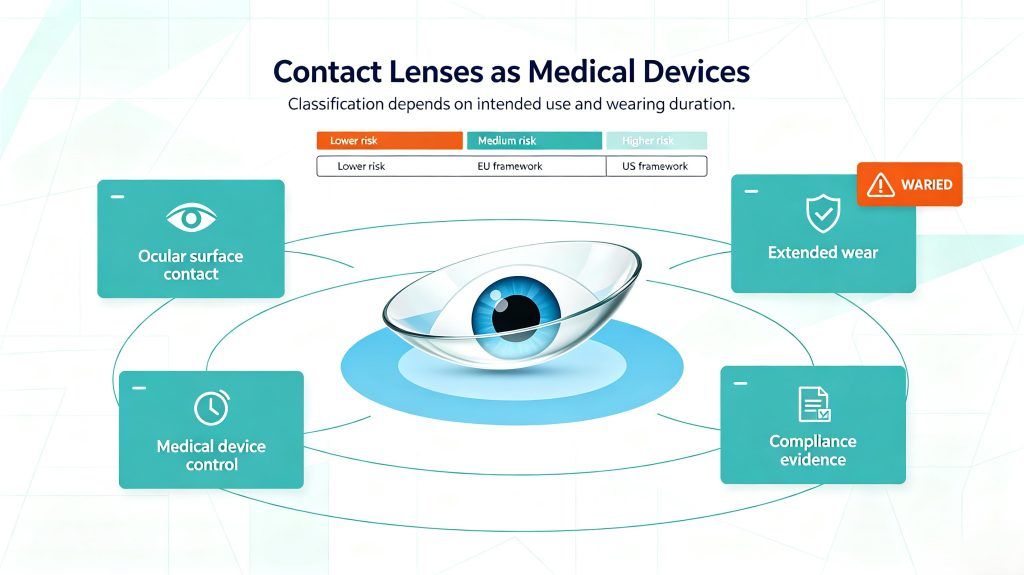
Contact lenses are not assigned a single fixed class. Their classification depends on intended use and duration of contact, and they may fall into Class IIa, Class IIb or Class III. In practice, short-term use generally corresponds to Class IIa, while long-term use corresponds to Class IIb.
This applies to products with and without a corrective function. Non-corrective contact lenses — including coloured lenses and lenses carrying prints or patterns — are covered by the MDR’s provisions for products without an intended medical purpose. Guidance from the Medical Device Coordination Group places short-term non-corrective contact lenses in Class IIa and their long-term counterparts in Class IIb.
Conformity Assessment and the Notified Body
Class IIa, IIb and III devices require the involvement of a notified body — an independent organisation designated to assess conformity. The manufacturer prepares technical documentation, including a clinical evaluation, and the notified body assesses it. Successful assessment allows the CE mark to be applied, and a Unique Device Identifier (UDI) is assigned to the device.
The US Framework: FDA Device Classification
In the United States, contact lenses are regulated under 21 CFR Part 886, which covers ophthalmic devices. The classification is set device type by device type.
Classification Under 21 CFR Part 886
| Regulation | Device | Class |
|---|---|---|
| 21 CFR 886.5925 | Soft (hydrophilic) contact lens | Class II if intended for daily wear only; Class III if intended for extended wear |
| 21 CFR 886.5916 | Rigid gas permeable contact lens | Class II if intended for daily wear only; Class III if intended for extended wear |
The dividing line is therefore not the material but the wearing regimen the device is intended for. Soft daily wear contact lenses, for example, are listed under product code LPL — “lenses, soft contact, daily wear” — as Class II devices.
Premarket Pathways
Class II and Class III follow different routes:
- Class II devices generally require premarket notification, commonly known as a 510(k). The FDA has published guidance specifically for Class II daily wear contact lenses covering this pathway.
- Class III devices require premarket approval — a more extensive process in which the manufacturer submits clinical and scientific evidence supporting safety and effectiveness.
Who Else Regulates Contact Lens Sales
Device regulation is not the only layer. In the US, the sale of contact lenses is regulated by both the FDA and the Federal Trade Commission. A valid prescription is required to purchase contact lenses, and this applies equally to decorative or cosmetic lenses that do not correct vision.
The Standards Behind the Requirements
Regulations set the obligations; technical standards describe how to meet them. Several standards are central to contact lenses.
Product standards — the ISO 18369 series, Ophthalmic optics — Contact lenses:
- Part 1: Vocabulary, classification system and recommendations for labelling specifications
- Part 2: Tolerances
- Part 3: Measurement methods
- Part 4: Physicochemical properties of contact lens materials
Labelling standards:
- ISO 11978 covers the information a manufacturer must provide for contact lenses and contact lens care products, so that they can be used correctly and safely. A later amendment addressed the legibility and accessibility of manufacturer information on packaging.
- ISO 14534 sets out fundamental requirements for contact lenses and contact lens care products.
Quality management:
- ISO 13485 specifies requirements for a quality management system specific to the medical device industry, covering design and development, risk management, and production and post-production processes.
- In the US, the FDA’s Quality Management System Regulation incorporates ISO 13485:2016 by reference — an example of a regulatory requirement being built directly on a published standard.
Labelling, Traceability and Post-Market Obligations
Approval is not the end of the process. Regulators increasingly require that devices remain identifiable and traceable throughout their life:
- Unique Device Identification — devices carry a UDI, allowing them to be identified through distribution and use.
- Labelling — the information supplied with a lens must meet the applicable labelling standard, covering the parameters a practitioner or wearer needs.
- Post-market surveillance — manufacturers are expected to monitor device performance after release and report relevant events to the competent authority.
Why Requirements Differ Between Markets
There is no single global approval for a contact lens. A device that is cleared in one jurisdiction still needs its own assessment elsewhere, because:
- classification rules differ, so the same product may land in different risk classes
- the evidence a regulator expects differs, particularly for clinical data
- some markets require a local registration holder or authorised representative
- labelling and language requirements vary by country
For anyone working with contact lenses across markets, the practical implication is that regulatory status is a per-market question, not a global one.
FAQ
Are contact lenses medical devices? Yes. Because they contact the ocular surface and are worn for extended periods, they are regulated as medical devices in major markets including the EU and the US.
What class are contact lenses in the EU? There is no single answer. Under the MDR, classification depends on intended use and duration of contact; contact lenses may be Class IIa, Class IIb or Class III. Short-term use generally maps to Class IIa and long-term use to Class IIb.
What class are contact lenses in the US? It depends on the device type and wearing regimen. Soft (hydrophilic) and rigid gas permeable contact lenses are Class II if intended for daily wear only, and Class III if intended for extended wear.
Do coloured or cosmetic contact lenses follow the same rules? In the EU, non-corrective lenses are covered by the MDR’s provisions for products without an intended medical purpose, with short-term use in Class IIa and long-term use in Class IIb. In the US, a valid prescription is required for all contact lenses, including decorative ones.
What is the difference between a 510(k) and a PMA? A 510(k) is a premarket notification, the route generally used for Class II devices. A PMA is a premarket approval application, the more extensive route required for Class III devices.
Why is ISO 13485 relevant to contact lenses? It defines the quality management system requirements for medical device manufacturers. The FDA’s Quality Management System Regulation incorporates ISO 13485:2016 by reference, so the standard is embedded in US requirements as well.
Does a CE mark mean a lens can be sold anywhere? No. A CE mark applies to the European market. Other jurisdictions run their own assessment processes.
Related Terms
Medical Device Regulation (MDR) · Class IIa · Class IIb · Class III · Notified Body · CE Marking · Unique Device Identification (UDI) · 510(k) Premarket Notification · Premarket Approval (PMA) · ISO 13485 · ISO 18369 · Post-Market Surveillance
待 Glossary 建好后,把上列术语逐个加内链;当前可先链到
/category/regulatory/与/category/manufacturing/。
Sources
European Union
- Regulation (EU) 2017/745 on medical devices (MDR), full text: https://eur-lex.europa.eu/eli/reg/2017/745/oj/eng
- MDCG 2023-5, Guidance on qualification and classification of Annex XVI products: https://health.ec.europa.eu/document/download/ea4acf26-979a-4dbb-92ff-8d1d804da51a_en?filename=mdcg_2023-5_en.pdf
- Team-NB, When would a notified body be involved in relation to contact lenses under MDR 2017/745?: https://www.team-nb.org/faq-items/when-would-a-notified-body-be-involved-in-relation-to-contact-lenses-under-mdr-2017-745/
- EU MDR classification rules (Annex VIII) overview: https://meddeviceguide.com/blog/eu-mdr-classification-rules-annex-viii-guide
United States
- 21 CFR 886.5925 — Soft (hydrophilic) contact lens: https://www.ecfr.gov/current/title-21/chapter-I/subchapter-H/part-886/subpart-F/section-886.5925
- 21 CFR 886.5916 — Rigid gas permeable contact lens: https://www.ecfr.gov/current/title-21/chapter-I/subchapter-H/part-886/subpart-F/section-886.5916
- FDA product classification, code LPL (lenses, soft contact, daily wear): https://www.accessdata.fda.gov/scripts/cdrh/cfdocs/cfpcd/classification.cfm?ID=LPL
- FDA, Class II Daily Wear Contact Lenses — Premarket Notification [510(k)] Guidance Document: https://www.fda.gov/medical-devices/guidance-documents-medical-devices-and-radiation-emitting-products/class-ii-daily-wear-contact-lenses-premarket-notification-510k-guidance-document
- FDA, Buying Contact Lenses (FDA and FTC oversight; prescription requirement): https://www.fda.gov/medical-devices/contact-lenses/buying-contact-lenses
- FDA, Decorative Contact Lenses: https://www.fda.gov/medical-devices/contact-lenses/decorative-contact-lenses-halloween-and-more
- FDA, Types of Contact Lenses: https://www.fda.gov/medical-devices/contact-lenses/types-contact-lenses
- FDA, Quality Management System Regulation (QMSR) — incorporates ISO 13485:2016 by reference: https://www.fda.gov/medical-devices/postmarket-requirements-devices/quality-management-system-regulation-qmsr
Standards
- ISO 18369-1:2017 — Ophthalmic optics — Contact lenses — Part 1: Vocabulary, classification system and recommendations for labelling specifications: https://www.iso.org/obp/ui/#iso:std:iso:18369:-1:ed-2:v2:en
- ISO 18369 series overview (Parts 1–4): https://www.iso.org/obp/ui#iso:std:iso:18369:-4:ed-1:en
- ISO 11978:2017 — Contact lenses and contact lens care products — Labelling: https://www.iso.org/standard/72603.html
- ISO 14534 — Ophthalmic optics — Contact lenses and contact lens care products — Fundamental requirements: https://www.iso.org/obp/ui/#iso:std:iso:14534:ed-3:v1:en
- ISO 13485:2016 — Medical devices — Quality management systems: https://www.iso.org/standard/59752.html