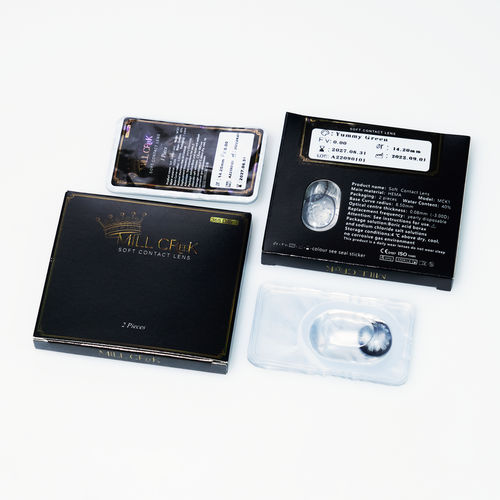

The moment a buyer moves from ordering samples to placing a wholesale order, the constraint changes. Price stops being the main variable and lead time, documentation and stock continuity take over. Most first-order failures are not commercial — they are structural, and they are predictable.
Minimum order quantity is three numbers, not one
A quoted MOQ usually hides three separate thresholds, and they apply at different levels:
- Per style. The minimum for a single colour or pattern.
- Per power. The minimum for each prescription within that style — this is the number that catches buyers out, because a range of plano to −8.00 multiplies quickly.
- Per order. The total below which the factory will not schedule a run at all.
A supplier quoting “1,000 pieces” may mean 1,000 per style, or 1,000 across the order with a 300-per-power floor. Ask which, in writing, before building a range around the number.
Stock and production are different lead times
Two order types behave completely differently and are often quoted as one:
| Order type | What drives the timeline | What to confirm |
|---|---|---|
| Stock (existing styles, existing packaging) | Picking, QC and dispatch | Current stock depth per power, and whether it is reserved on order or on payment |
| Production (new style, new packaging, private label) | Artwork approval, tooling or plate setup, production slot, QC, packing | Which stages are on the critical path, and who signs off artwork |
The recurring delay in private label is artwork. Approval cycles that take two weeks in the buyer’s organisation consume the factory’s production slot, and the order slips by a month without anyone being at fault.
Documentation scales with the order
A sample envelope needs almost nothing. A wholesale shipment needs a technical file that matches the product, a declaration of conformity where the market requires one, and labelling in the language of the destination. Three mismatches account for most customs holds:
- The model designation on the certificate differs from the carton.
- The manufacturer address on the label differs from the certificate.
- The label language is not the one required at destination.
None of these is a manufacturing defect, and all of them stop a shipment.
Payment terms carry the risk, not the price
First orders are usually deposit-and-balance, and the balance is usually released against shipping documents rather than against receipt. What protects the buyer is not the percentage but the inspection point: whether a pre-shipment inspection is allowed, who performs it, and what happens if the result falls outside the agreed tolerance.
Agree the acceptance criteria before production, not after. AQL limits, the parameters being checked — power, diameter, water content, packaging integrity — and the remedy if a lot fails. A supplier who resists writing this down is telling you something.
The five questions that prevent a first-order failure
- Is the MOQ per style, per power, or per order? Get the number for each level.
- Is this stock or production? And if production, which stage is the critical path?
- Who approves artwork, and how long does that take? Build it into the launch date.
- Which documents ship with the goods? Check model, manufacturer address and label language against the certificate.
- What is the acceptance criteria and who inspects? In writing, before the run.
Scaling from a sample order is a documentation exercise more than a purchasing one. The buyers who scale cleanly are the ones who treated the first wholesale order as a process to be specified, not a price to be negotiated.
FAQ
Is MOQ per style, per power, or per order? All three thresholds can apply at once. Ask for the number at each level before building a range, because a run from plano to −8.00 multiplies the per-power floor quickly.
What usually delays a first wholesale order? Artwork approval. Approval cycles on the buyer’s side consume the factory’s production slot, and the order slips by weeks without anyone being at fault.
What should be agreed before production starts? Acceptance criteria and the inspection point: AQL limits, which parameters are checked, who performs the inspection, and the remedy if a lot falls outside tolerance.