 kangshida
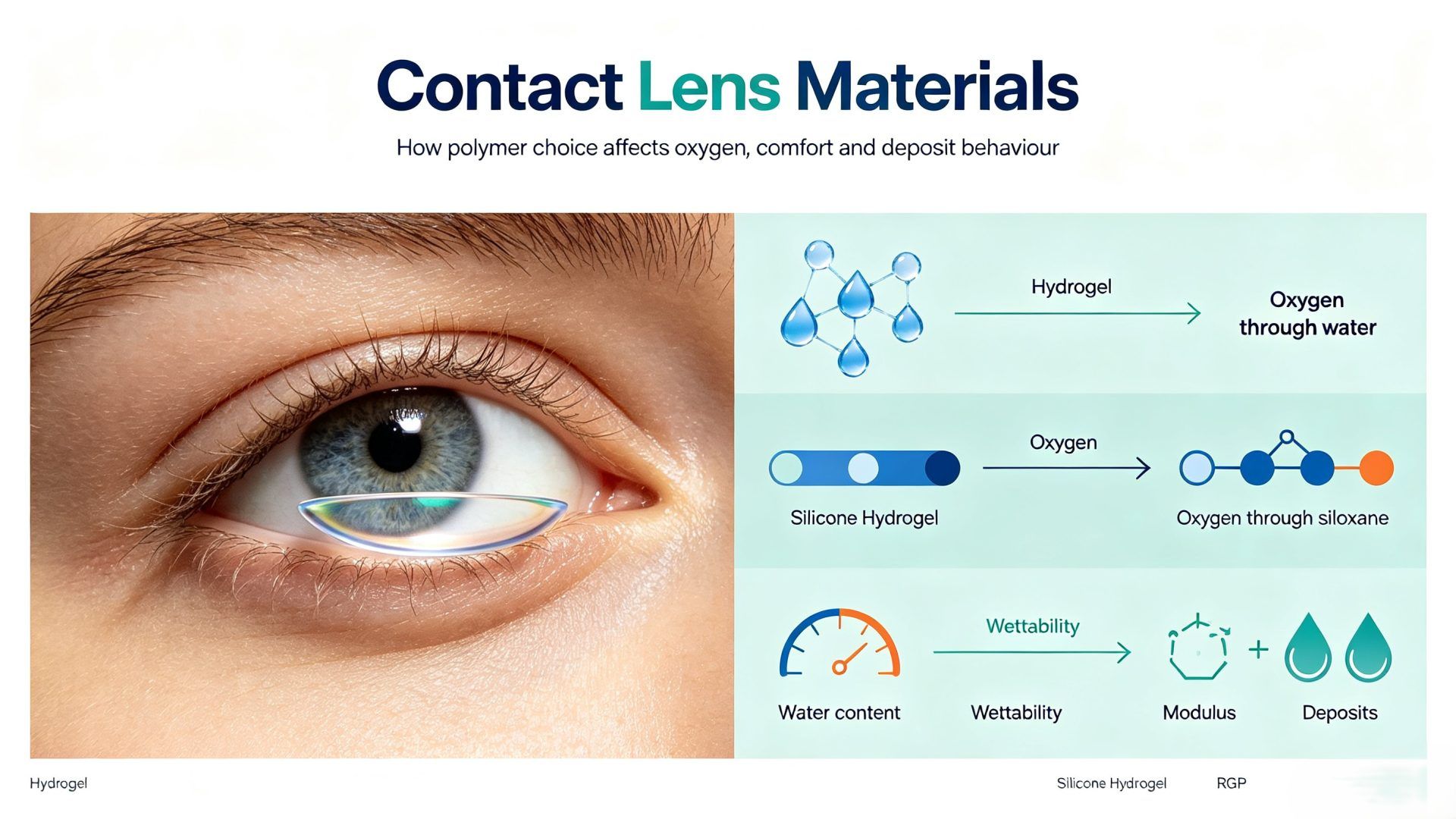
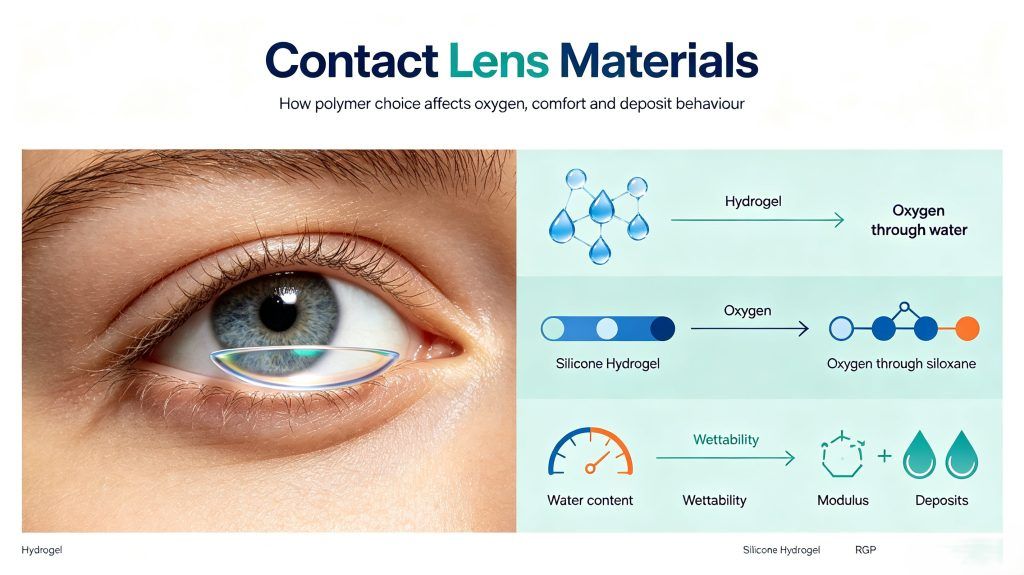
A contact lens sits on the surface of the eye for hours at a time. Its material determines how much oxygen reaches the cornea, how the lens behaves when it dries slightly between blinks, how comfortably it moves, and how deposits accumulate on its surface. Two lenses with identical dimensions can perform very differently if they are made from different polymers.
This article covers the main material families used in soft and rigid contact lenses, the classification systems applied to them, and the properties that are most often cited when materials are compared.
Hydrogel Materials and the Role of HEMA
The first soft contact lenses were made from a hydrogel — a cross-linked polymer network that holds water within its structure. The founding material was poly(2-hydroxyethyl methacrylate), usually shortened to pHEMA. It was developed by Drahoslav Lim and Otto Wichterle, whose cross-linked gel absorbed up to around 40% water while remaining transparent and mechanically workable.
HEMA is the monomer; it is also described as ethylene glycol monomethacrylate. In lens manufacture it is copolymerised with a cross-linking agent such as ethylene dimethacrylate (EDMA), which links the polymer chains into a three-dimensional network. Water is absorbed into the spaces within that network.
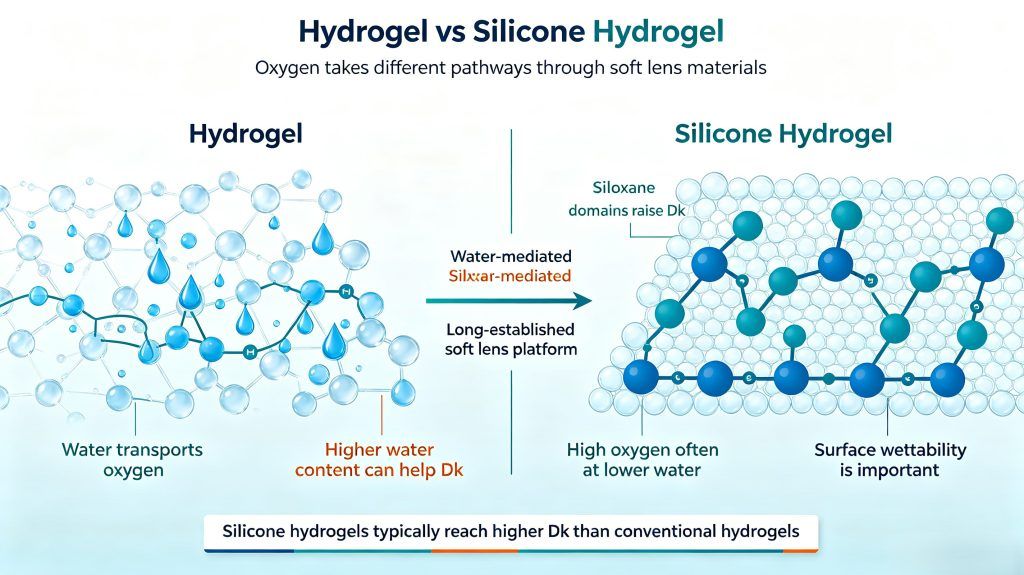
Hydrogel materials have been in use since the 1960s and remain the basis of many conventional soft lenses. Their defining characteristic is that oxygen travels through the water contained in the polymer, rather than through the polymer itself. That single fact explains most of the trade-offs discussed later in this article.
Silicone Hydrogel: Adding Siloxane to the Polymer
Silicone hydrogel materials were developed to raise oxygen transmission while keeping the comfort properties of a soft lens. They are produced by copolymerising hydrophilic methacrylate or vinyl macromers with methacrylate- or vinyl-terminated polydimethylsiloxanes (PDMS), along with additional co-monomers.
Common building blocks include:
- TRIS — 3-(methacryloyloxy)propyltris(trimethylsiloxy)silane, a hydrophobic siloxane-bearing monomer that raises oxygen permeability
- DMA — N,N-dimethylacrylamide, a hydrophilic co-monomer
- NVP — 1-vinyl-2-pyrrolidinone, also hydrophilic
Because silicone is hydrophobic while the eye surface is hydrophilic, silicone hydrogel lenses need a strategy for surface wettability. Two broad approaches are used:
- Surface treatment — the finished lens surface is modified or coated to make it more wettable.
- Internal wetting agents — a hydrophilic polymer such as polyvinyl pyrrolidone (PVP) is incorporated into the material itself. Some later silicone hydrogel materials rely on this approach rather than a surface treatment.
Water Content and Ionicity: The Four Material Groups
Hydrogel materials are commonly described using a four-group system that combines water content and ionicity. The classification originates with the US Food and Drug Administration and is also reflected in ISO 18369-1.
| Group | Water content | Ionicity |
|---|---|---|
| Group I | Low (below 50%) | Non-ionic |
| Group II | High (above 50%) | Non-ionic |
| Group III | Low (below 50%) | Ionic |
| Group IV | High (above 50%) | Ionic |
Whether a material counts as ionic or non-ionic is assessed at pH 7.2. Ionic materials tend to attract more protein deposits than non-ionic materials, which is one reason the grouping remains useful when discussing deposit behaviour.
Note that this system was devised for conventional hydrogels. Silicone hydrogel materials have a different composition, and grouping systems for them have been proposed separately.
Oxygen Permeability (Dk) and Oxygen Transmissibility (Dk/t)
Two related values appear constantly in material discussions, and they are not interchangeable.
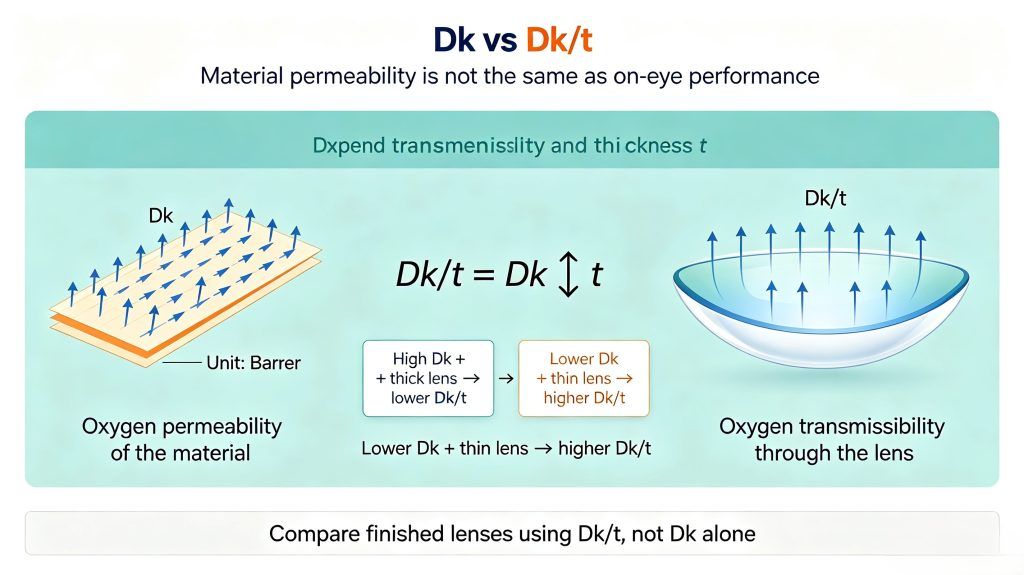
- Dk is the oxygen permeability of the material itself. It describes how readily oxygen diffuses through the polymer and is conventionally expressed in Barrer units. Dk is a property of the material.
- Dk/t is the oxygen transmissibility of the finished lens. It divides permeability by lens thickness (t), so it describes how much oxygen actually reaches the cornea through a specific lens.
Because Dk/t depends on thickness, a thick lens made from a highly permeable material can deliver less oxygen than a thin lens made from a less permeable one. This is why material comparisons based on Dk alone can be misleading.
Why Higher Water Content Is Not Automatically Better
Water content is often treated as a quality signal, but the relationship is not that simple.
- In conventional hydrogels, oxygen travels through the water in the material, so water content and oxygen permeability are linked. Hydrogels generally have higher water content but substantially lower oxygen permeability than silicone hydrogels.
- High water content also means a larger proportion of the lens is water that can be lost to evaporation. Historically, high-water-content lenses had to be made thicker to manage dehydration, which reduced some of the oxygen benefit.
- In silicone hydrogel materials, oxygen travels through the siloxane component rather than the water, so high water content is not required for high oxygen permeability. Water content is not a proxy for oxygen performance.
Mechanical behaviour also differs between families. Silicone hydrogel materials are generally stiffer — they have a higher modulus — than conventional hydrogels, a consequence of the siloxane species in the polymer. Modulus affects how a lens drapes on the eye and how it behaves during handling.
How Materials Are Named and Classified
Contact lens materials follow naming conventions that encode their general type. In the US system, the stem -filcon is used for hydrophilic materials with a water content of 10% or more, while -focon is used for other materials. These stems are attached to a prefix that identifies the specific polymer.
The ISO 18369 series, Ophthalmic optics — Contact lenses, provides the wider framework:
- Part 1: Vocabulary, classification system and recommendations for labelling specifications
- Part 2: Tolerances
- Part 3: Measurement methods
- Part 4: Physicochemical properties of contact lens materials
Part 4 is the part most directly concerned with material characteristics; Part 2 sets the tolerance limits for the principal optical and physical parameters of rigid corneal, rigid scleral and soft contact lenses.
Rigid Gas Permeable Materials
Not all contact lenses are hydrogels. Rigid gas permeable (RGP) lenses are made from rigid polymers that hold their own shape rather than draping to the cornea, and they transmit oxygen without relying on water content. They are classified separately from soft lenses in both the ISO framework and the US regulatory system.
FAQ
What is the difference between hydrogel and silicone hydrogel? Conventional hydrogels transmit oxygen through the water held in the polymer. Silicone hydrogels add siloxane components so that oxygen can pass through the material itself. Silicone hydrogels therefore reach much higher oxygen permeability, often at lower water content.
Does higher water content mean more oxygen? In conventional hydrogels, the two are related. In silicone hydrogels, they are largely decoupled — oxygen travels through the siloxane component, so a low-water silicone hydrogel can be more oxygen permeable than a high-water conventional hydrogel.
What does Dk measure, and how is it different from Dk/t? Dk measures the oxygen permeability of the material. Dk/t measures oxygen transmissibility of the finished lens and factors in lens thickness, so it is the more relevant figure when comparing two lenses of different thickness.
What are the four hydrogel groups based on? Water content (above or below 50%) and ionicity (ionic or non-ionic, assessed at pH 7.2).
Why are some materials described as ionic? Ionicity describes whether the polymer network carries charged groups. Ionic materials tend to attract more protein deposits than non-ionic materials.
What does the “-filcon” suffix mean? It is the naming stem used for hydrophilic contact lens materials with a water content of 10% or more. Non-hydrophilic materials use the stem “-focon”.
Are silicone hydrogel lenses always more comfortable? Comfort is influenced by several factors beyond material family, including modulus, surface wettability, fit and the individual wearer. Material family is one input among several, not a single determinant.
Related Terms
Hydrogel · Silicone Hydrogel · HEMA · Water Content · Ionicity · Oxygen Permeability (Dk) · Oxygen Transmissibility (Dk/t) · Lens Modulus · Rigid Gas Permeable (RGP)
待 Glossary 建好后,把上列术语逐个加内链;当前可先链到
/category/materials/与/category/lens-design/。
Sources
- ISO 18369-1:2017 — Ophthalmic optics — Contact lenses — Part 1: Vocabulary, classification system and recommendations for labelling specifications: https://www.iso.org/obp/ui/#iso:std:iso:18369:-1:ed-2:v2:en
- ISO 18369-2:2017 — Ophthalmic optics — Contact lenses — Part 2: Tolerances: https://www.iso.org/obp/ui/#iso:std:iso:18369:-2:ed-3:v1:en
- ISO 18369 series overview (Parts 1–4): https://www.iso.org/obp/ui#iso:std:iso:18369:-4:ed-1:en
- FDA, DeskScan II (contact lens material naming conventions): https://www.fda.gov/media/72659/download
- Silicone hydrogels: four decades of new chemistry in contact lenses, Contact Lens Spectrum: https://clspectrum.com/issues/2022/december/silicone-hydrogels-four-decades-of-new-chemistry-in-contact-lenses/
- The Evolution of Silicone Hydrogel Lenses, Contact Lens Spectrum: https://www.clspectrum.com/issues/2008/june/the-evolution-of-silicone-hydrogel-lenses
- Synthesis and Characterization of Silicone Contact Lenses (TRIS, DMA, NVP, HEMA composition): https://pmc.ncbi.nlm.nih.gov/articles/PMC6630243/
- Hydrogels: from soft contact lenses and implants to self-assembled nanomaterials (HEMA/EDMA copolymerisation): https://pmc.ncbi.nlm.nih.gov/articles/PMC2776732/
- Silicone hydrogel versus hydrogel soft contact lenses (water content and oxygen permeability comparison): https://pmc.ncbi.nlm.nih.gov/articles/PMC8110199/
- Topical review: Twenty-five years of silicone hydrogel soft contact lenses (modulus of SiHy materials): https://pmc.ncbi.nlm.nih.gov/articles/PMC12184980/
- Contact Lens Oxygen Permeability (Dk) Explained (Dk vs Dk/t): https://www.opterio.com/learn/contact-lens-materials-oxygen-permeability
- Understanding the Influence of Water Content in Soft Lenses, Review of Optometry: https://www.reviewofoptometry.com/article/understanding-the-influence-of-water-content-in-soft-lenses