 kangshida
What Is Graphic Diameter?
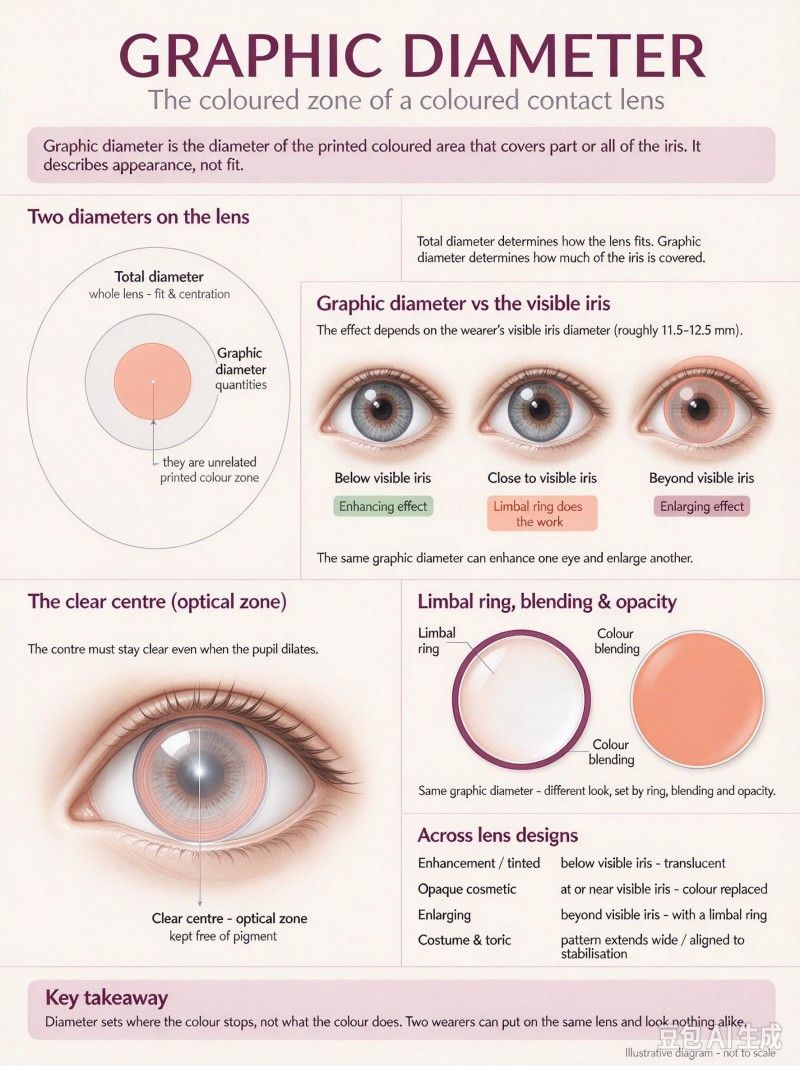
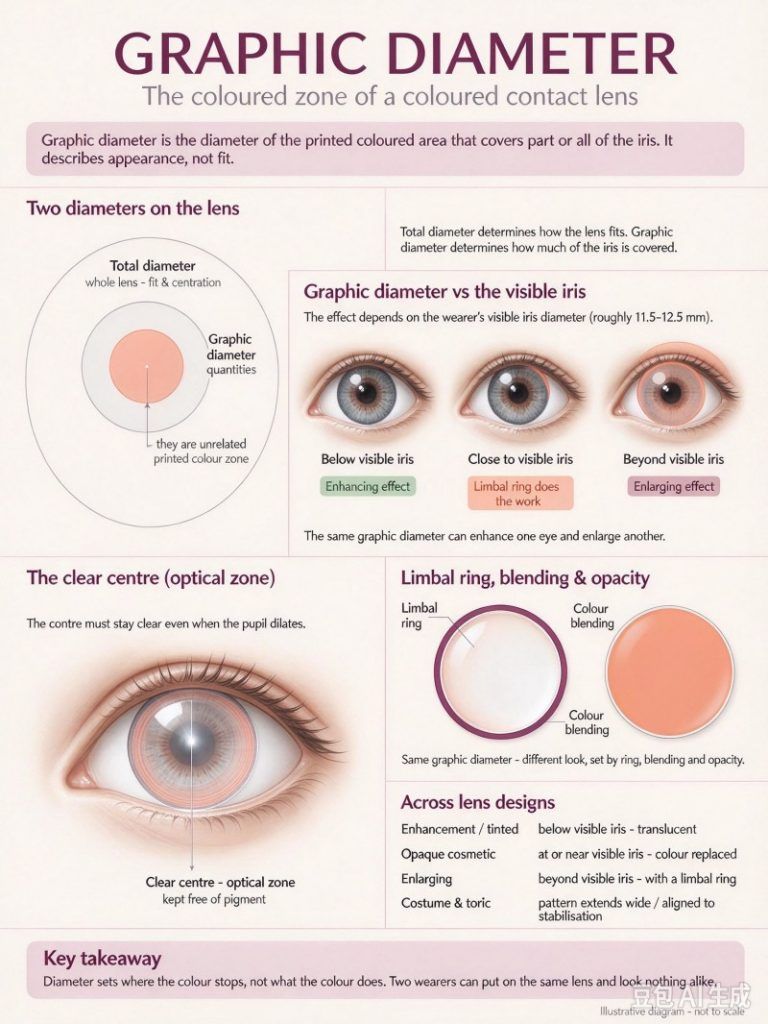
Graphic diameter is the diameter of the coloured zone of a coloured contact lens — the printed area that covers part or all of the iris.
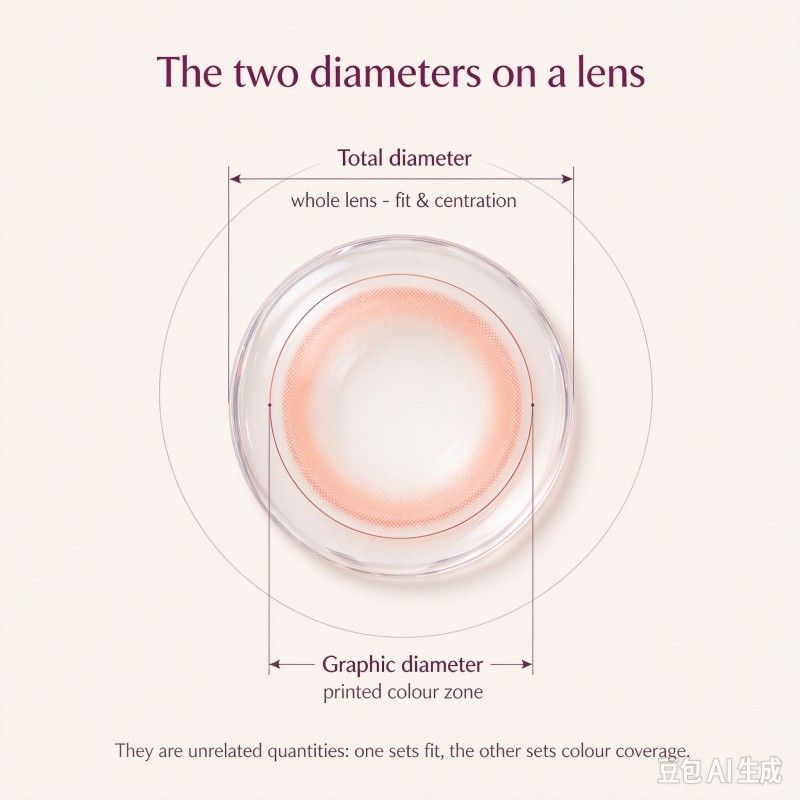
It is one of the two diameters that appear on a coloured lens specification, and it is the one that describes appearance rather than fit:
- Total diameter — the dimension of the whole lens. A geometric parameter that participates in how the lens fits and centres.
- Graphic diameter — the dimension of the printed colour area. A design parameter that determines how much of the iris is covered and how the lens reads on the eye.
The two are frequently confused because both are usually written simply as “diameter” in product listings. They are unrelated quantities: a lens can keep the same total diameter while its graphic diameter changes, and the same graphic diameter can be built into lenses of different total diameters.
Terminology varies between manufacturers and markets. The same measurement is also described as the iris zone diameter, the colour zone diameter, or the printed diameter. What the terms share is the outer boundary of the coloured area.
A worked example
Take a lens specified at 14.2 mm total diameter with a 13.0 mm graphic diameter. The coloured zone is 1.2 mm narrower than the lens as a whole, which leaves 0.6 mm of clear margin on each side. Whether that margin is enough depends on the wearer, and on where the lens comes to rest — see the section on the visible iris below.
How Graphic Diameter Relates to the Visible Iris
Graphic diameter only becomes meaningful against one reference: the wearer’s visible iris diameter — the width of the iris as it appears, from limbus to limbus.
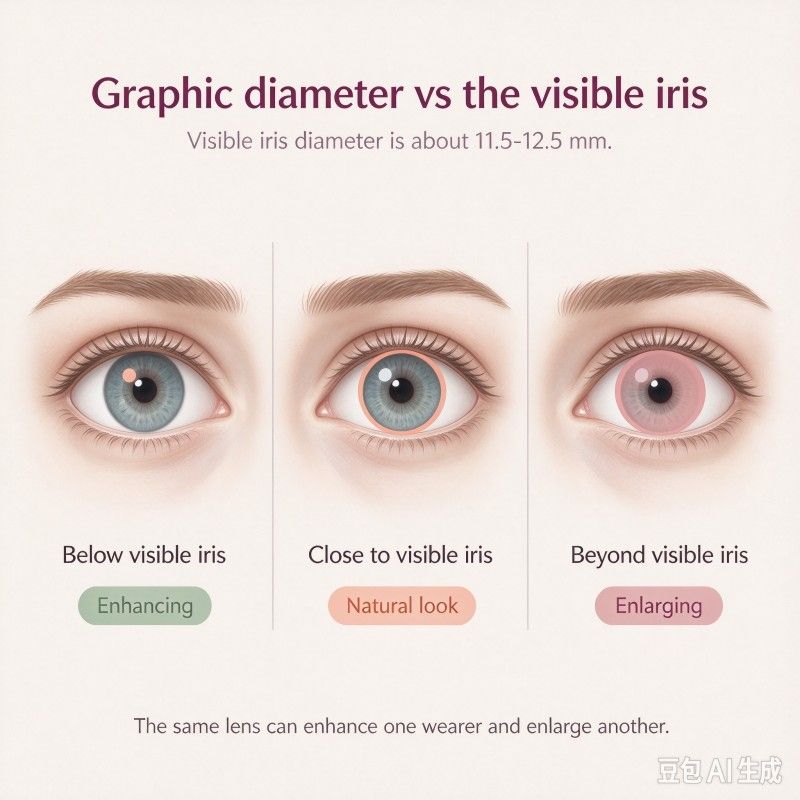
The visible iris diameter in adults is commonly reported as roughly 11.5 to 12.5 mm, with variation between individuals and between populations. Against that reference, graphic diameter produces three recognisably different effects:
| Graphic diameter | What happens on the eye |
|---|---|
| Clearly below the visible iris diameter | Colour sits inside the iris, leaving the natural limbus visible. Typically described as an enhancing effect: the existing colour is deepened rather than replaced. |
| Close to the visible iris diameter | Colour approaches the limbus and the boundary is read as the edge of the iris. This is where the limbal ring design does most of its work. |
| Beyond the visible iris diameter | Colour extends past the limbus. The iris reads larger, and the outer edge of the pattern becomes visible against the white of the eye. |
This is the single most important point about graphic diameter: it is not an absolute dial that makes an eye look natural or unnatural. The same graphic diameter produces an enhancing effect on a wearer with a large visible iris and an enlarging effect on a wearer with a small one. That is why two people can wear the same lens and look nothing alike.
The Clear Centre: Graphic Diameter and the Optical Zone
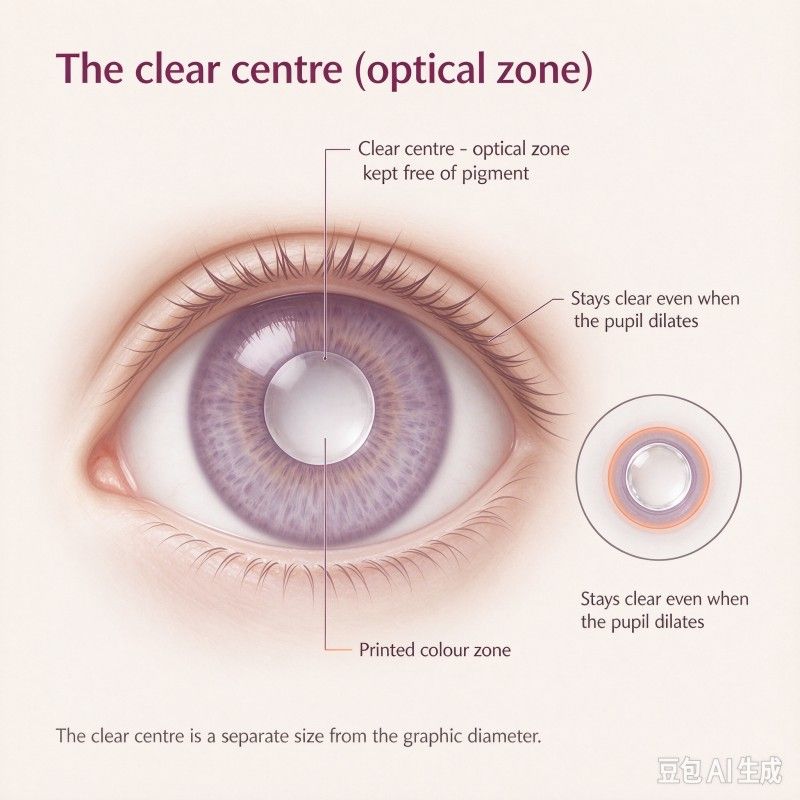
A coloured lens is not coloured all the way across. The central area over the pupil is left clear, and pigment is kept out of what is normally called the optical zone — the region that has to transmit a usable image.
Three practical consequences follow.
The clear centre is a separate dimension from the graphic diameter. A design with a large graphic diameter does not automatically have a small clear centre, and a design with a small graphic diameter does not automatically have a large one. They are specified independently, and both appear in the pattern artwork.
The clear centre has to remain clear when the pupil dilates. Pupil diameter varies with illumination and narrows with age, so the centre is sized to stay clear at the largest pupil the wearer is likely to have. A pattern that crowds the pupil margin can appear to shift as the pupil changes size, even though the printed graphic has not moved at all.
Colour that reaches the pupil edge reads as printed. The pupil is the highest-contrast feature in the eye. A pattern that encroaches on it stops looking like iris texture.
Graphic Diameter, Limbal Ring and Colour Blending
Graphic diameter sets one boundary. The way that boundary is finished is a separate set of decisions, and it changes the result as much as the diameter itself.
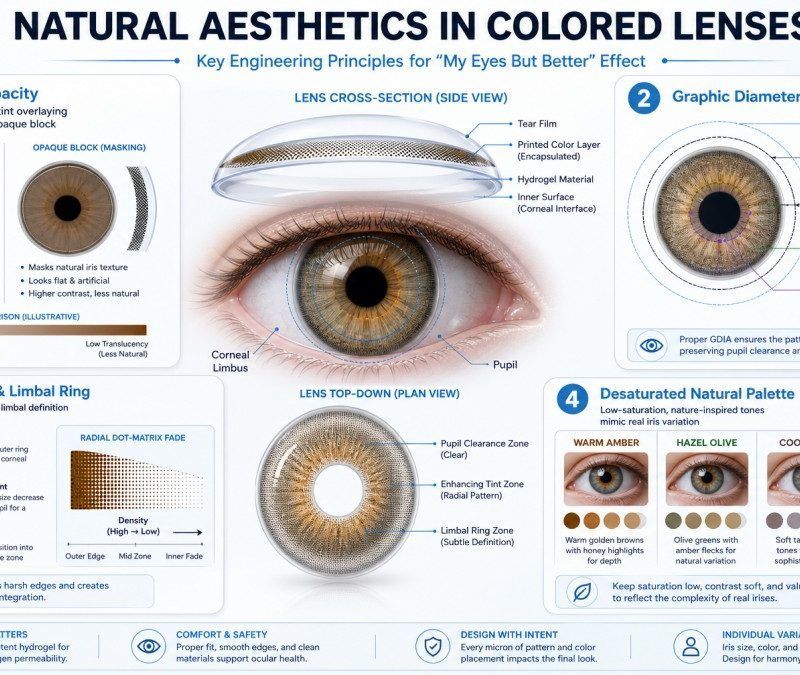
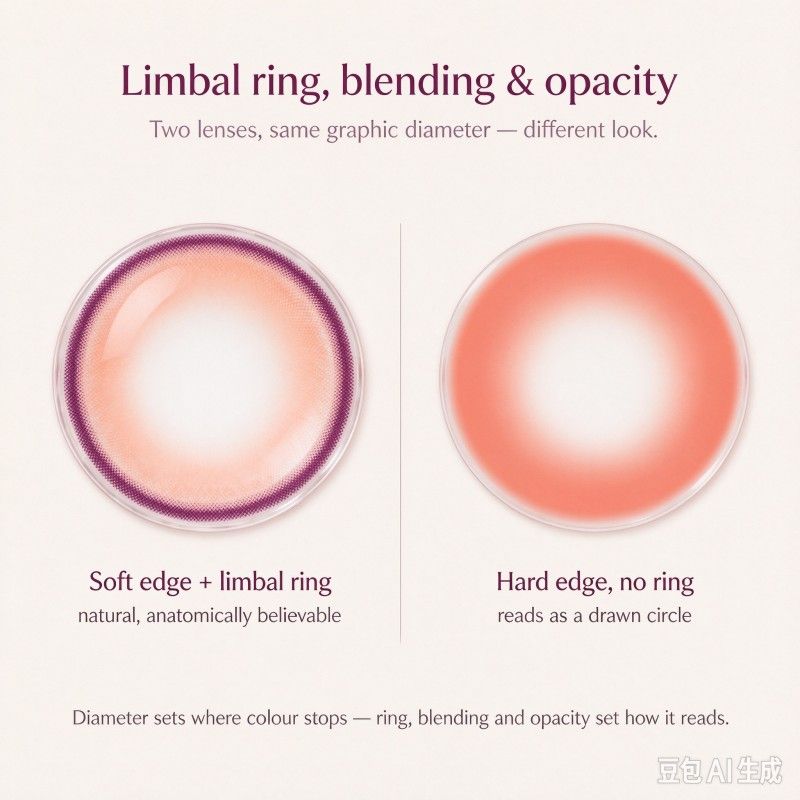
The limbal ring is a darker band placed at or near the outer boundary of the pattern. A defined ring gives the iris a clear outer edge; a ring that is too dark, too thick, or positioned outside the natural limbus reads as a drawn circle rather than as anatomy.
Colour blending is how the inner edge of the pattern meets the pupil and how the colour is distributed across the zone. Radial gradients, feathered edges and multi-layer printing are the common techniques. A hard-edged pattern with the same graphic diameter as a feathered one will look noticeably more artificial.
Opacity decides whether the natural iris shows through. A translucent overlay intensifies the wearer’s own colour; an opaque layer replaces it.
Two lenses with identical graphic diameters and identical total diameters can therefore look completely different. Diameter describes where the colour stops, not what the colour does.
Graphic Diameter Across Lens Designs
| Design family | Typical use of graphic diameter |
|---|---|
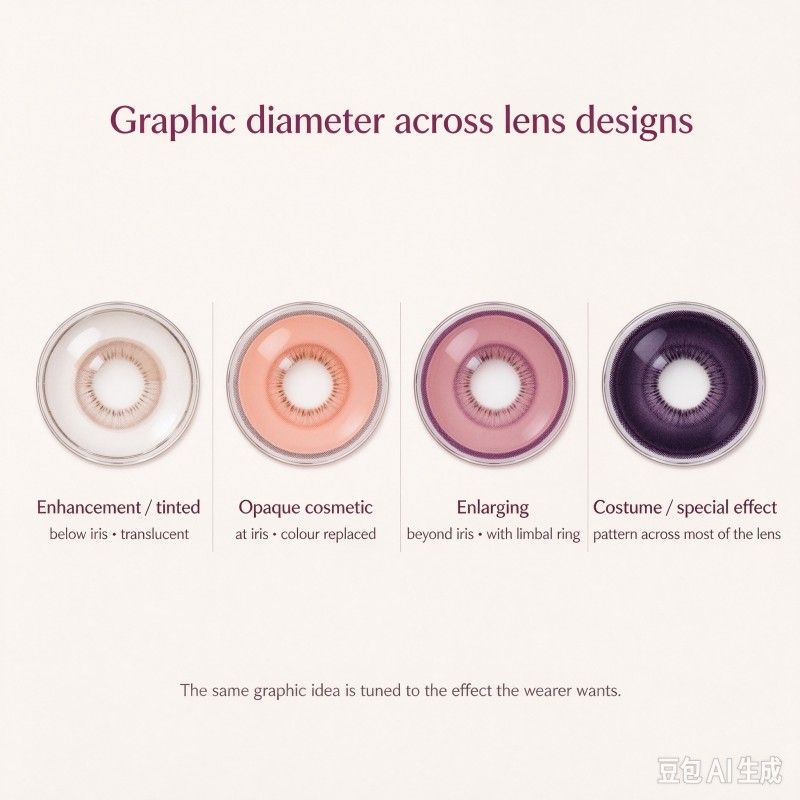
| Enhancement / tinted | Graphic diameter below the visible iris diameter, translucent colour, natural limbus left visible. |
| Opaque cosmetic | Graphic diameter at or near the visible iris diameter, with the natural colour replaced. |
| Enlarging designs | Graphic diameter at or beyond the visible iris diameter, usually paired with a pronounced limbal ring. |
| Costume and special effect | Pattern often extends across most or all of the lens, with the graphic diameter approaching the total diameter. |
| Powered and toric cosmetic lenses | The printed zone has to sit concentric with the optical zone; on toric designs the graphic is aligned to the lens’s stabilisation feature so the pattern stays in the intended orientation. |
Replacement cycle is independent of graphic diameter. Daily, monthly and yearly lenses can carry the same graphic; what differs is the material, the packaging and the wearing schedule.
How Graphic Diameter Is Set in Manufacturing
Graphic diameter is fixed at the design stage and then carried through production by two things: the pattern artwork and the mould.
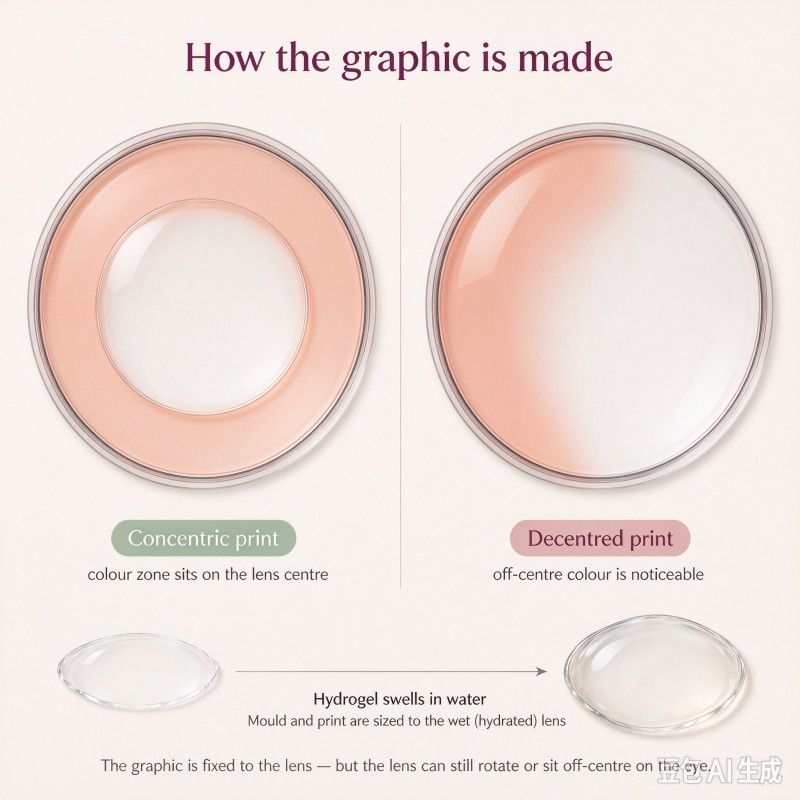
The printed layer must be concentric with the lens geometry. If printing is decentred relative to the lens, the colour zone is off-centre as well — and because the eye reads symmetry between the two eyes, a decentred graphic is more noticeable than a small difference in diameter.
Soft lens dimensions are specified in the hydrated state. Hydrogel lenses take up water and swell, so the dimensions of the dry lens and the finished lens are not the same; mould and print artwork are sized to land on the intended wet dimensions rather than the dry ones. The printed layer itself is produced by a printing process, and the way the pigment is held in the lens structure affects durability and safety as much as appearance — that mechanism is covered separately in the article on pigment encapsulation.
A printed graphic is a design feature rather than one of the optical parameters of a lens, so how tightly graphic diameter is held is normally defined by the manufacturer’s own design specification. The principal optical and geometric parameters are covered by the ISO 18369 series, which sets out the vocabulary, the tolerances and the measurement methods for contact lenses; standard designations are given in the references below without links.
Finally, one distinction that is easy to lose: the graphic is fixed to the lens, but the lens is not fixed to the eye. A soft lens can rotate and can come to rest decentred, so the position of the pattern on the eye is not guaranteed by the measurement. Designs that depend on an asymmetric graphic therefore have to consider rotation and centration separately from graphic diameter — the reasoning behind that constraint is set out in the article on stable highlight positioning.
Common Misconceptions
“Graphic diameter is the lens diameter.” They are two different measurements, usually printed next to each other.
“A bigger graphic diameter makes the eye look bigger.” Diameter sets the outer boundary, but the perceived size of the iris is driven at least as much by the limbal ring, the contrast between the colour and the sclera, and the opacity of the pattern.
“Graphic diameter is the size of the clear pupil area.” They are separate dimensions, specified independently.
“More graphic diameter means more pigment.” Graphic diameter describes where colour is placed. How much pigment is deposited depends on opacity and pattern density.
“Two lenses with the same graphic diameter look the same.” Only if the limbal ring, blending, opacity, colour and total diameter also match.
“Graphic diameter is a standardised parameter like base curve.” It is a printed design feature of coloured lenses, described in the industry’s own terms rather than in the vocabulary used for the principal optical parameters.
FAQ
Does graphic diameter affect vision? It should not, because the optical zone is kept clear of pigment. Graphic diameter describes the coloured area around that zone, not the zone itself.
How is graphic diameter measured? Across the outer boundary of the coloured area, on the finished lens in its hydrated state.
What graphic diameter looks most natural? One at or below the wearer’s own visible iris diameter, finished with a soft edge and a limbal ring that sits inside the natural limbus. There is no single number, because visible iris diameter differs from person to person.
Why does my coloured lens look more dramatic than the specification suggested? Diameter is only one variable. A pronounced limbal ring, high opacity and a hard pattern edge will all increase the effect at the same graphic diameter.
Can the graphic diameter be changed on an existing design? It is a change to the pattern artwork and often to the mould, so it is a new design rather than an adjustment. It also cannot be changed by the wearer.
Do graphic diameters differ between daily and monthly lenses? Not as a rule. Replacement cycle is determined by the material and the intended wearing schedule; the graphic is a separate design decision.
Does graphic diameter matter on prescription coloured lenses? Yes. A powered coloured lens still carries a printed graphic, and it still has to stay concentric with the optical zone.
Why can the same lens look different on each eye? Because the two eyes are rarely identical — visible iris diameter, lid position and pupil size all differ slightly, and the lens can come to rest in a different position on each eye.
Related Terms
Total diameter · optical zone · visible iris diameter · limbal ring · colour blending · graphic opacity · enlargement · lens centration and rotation · pigment encapsulation