 kangshida
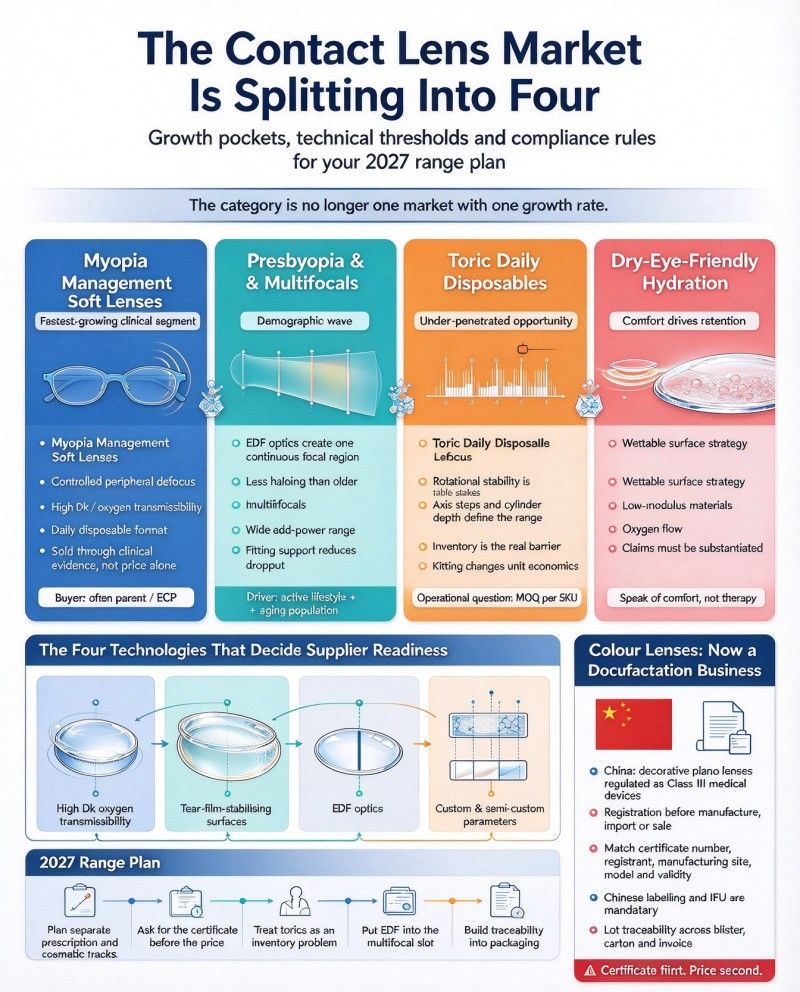
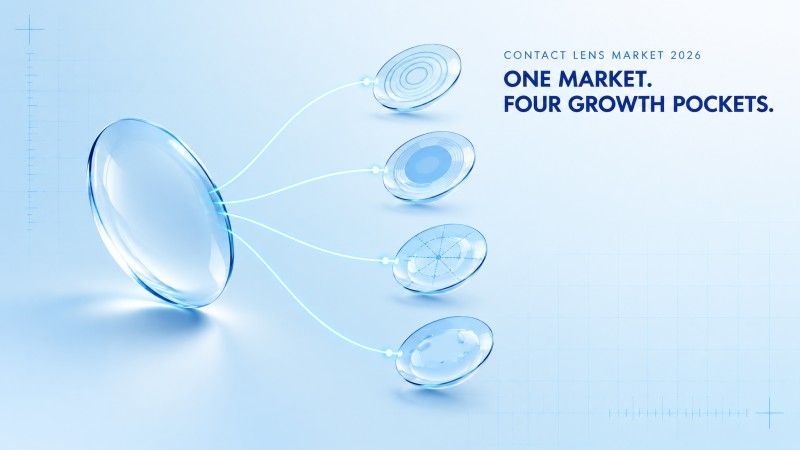
The contact lens category is no longer one market with one growth rate. It has split into four demand pockets that behave differently at the shelf, in the clinic, and on a purchase order: myopia management soft lenses, presbyopia multifocals , toric daily disposables, and dry-eye-friendly hydrating designs. Each is growing for its own reason, each demands a different technical capability from the factory, and each carries a different regulatory burden.
At the same time, the segment with the loudest consumer demand — cosmetic colour lenses — has become the segment with the heaviest documentation requirement. In China, decorative colour plano lenses are regulated as Class III medical devices, the highest risk class, and can only be manufactured or sold after registration. For cross-border sellers, that turns a fashion product into a paperwork product.
This article maps the four growth pockets, the four technologies that decide which supplier can serve them, and the compliance checks that now sit between a good design and a lawful sale.
The Numbers Behind the Split
Three data points explain why the category is fragmenting rather than simply expanding.
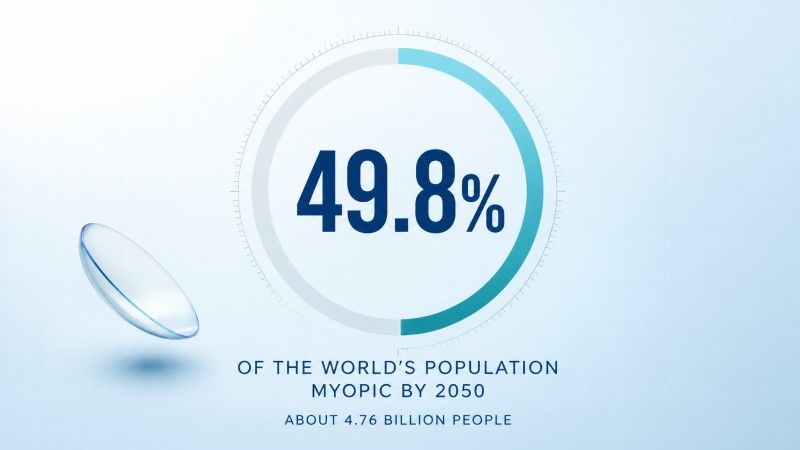
Myopia is becoming the default refractive state. The widely cited Holden projection estimated that by 2050 there will be 4,758 million people with myopia — 49.8% of the world population — including nearly one billion with high myopia (PubMed 26875007). A category that once served a minority is now serving roughly half of humanity.
Myopia control is the fastest-growing sub-segment. Third-party research puts myopia control lenses at roughly USD 1.5 billion in 2024, growing toward USD 6.9 billion by 2034 at a compound rate above 16% (InsightAce Analytic). Even discounted for vendor optimism, it is an order of magnitude faster than the base category.
Presbyopia is a demographic wave, not a niche. An estimated 1.8 billion people worldwide were living with presbyopia as of 2015 — roughly a quarter of the population — with the number expected to peak around 2030 as populations age (Presbyopia Physician). Multifocal contact lenses alone were valued near USD 2.8 billion in 2025, with a projected 6.9% CAGR to 2034 (Dataintelo).
A note on numbers: market-size estimates for these categories vary significantly between research vendors because definitions differ. Treat every figure here as directional evidence of where demand is moving, not as an audited fact.
Growth Pocket 1 — Myopia Management Soft Lenses
This is the only pocket where the buyer is not the wearer. The prescription comes from an eye care professional, the payment usually comes from a parent, and the decision is driven by a clinical outcome measured over years rather than a comfort impression measured over hours.
What drives demand: prevalence, plus a shift in clinical consensus that progression can be slowed rather than simply corrected. Once a category moves from “correct the refraction” to “modify the growth of the eye,” it stops competing on price per box and starts competing on evidence.
What the product has to do: produce controlled peripheral defocus while keeping central vision crisp, in a lens a child will actually wear for ten hours a day. That combination pushes designs toward daily disposable formats — no cleaning regime, no case hygiene failure, no lost lens drama on a school morning — and toward high oxygen transmissibility, because a growing eye is an actively metabolising one.
What brands get wrong: treating it as a repackaged sphere lens with a new carton. Myopia management sells through the clinic, and clinics ask for design rationale, fitting guidance, and a plausible evidence story. A supplier who cannot support a professional conversation will not survive in this pocket, no matter how competitive the price is.
Questions to put to a supplier: Which design principle does the lens use, and what data supports it? What is the paediatric fitting range in base curve, diameter, and power? Is there a fitting guide and a parent-facing explanation sheet? Can the lens be produced in a daily disposable format at scale?
Growth Pocket 2 — Presbyopia and the Multifocal Rebuild
Multifocals used to be the segment practitioners avoided because the drop-out rate was high and the chair time was long. Extended depth of focus has changed the conversation.
What changed technically: traditional alternating or simultaneous-image multifocals split light into discrete distance and near zones, which is efficient but produces halos, ghosting, and a narrow intermediate band. EDF optics instead create a single elongated focal region, trading a small amount of peak acuity for a continuous range — which matters enormously to a 52-year-old who spends the day moving between a laptop, a dashboard, and a dinner menu (Review of Optometry / GP Insights, Jan–Feb 2026).
What drives demand: the demographic curve above, plus the fact that this generation of presbyopes has no intention of giving up the active lifestyle they associate with not wearing spectacles.
What brands get wrong: shipping a multifocal design with no fitting support. The lens itself is now good enough that most failures are fitting failures or expectation failures — the patient was not told that adaptation takes one to two weeks and that night vision will feel different at first.
Questions to put to a supplier: Is the design centre-distance, centre-near, or EDF? What is the add power range and how many steps? What adaptation guidance comes with the lens? Can you supply a trial set that lets a practice fit across the add range without ordering individual boxes?
Growth Pocket 3 — Toric Daily Disposable
Astigmatism is common; toric penetration has historically lagged because toric lenses were seen as unstable, expensive, and inventory-heavy. Daily disposable has removed two of those three objections at once.
Why now: a daily lens is discarded before the deposit and comfort problems that plague reusable torics accumulate, and there is no cleaning solution to buy. The remaining objection is rotational stability — and modern stabilization designs have largely answered it.
The real barrier is inventory, not optics. A toric range multiplies sphere powers by cylinder powers by axis steps. A range with four cylinders and 10-degree axis steps generates several times the SKU count of the equivalent sphere range. That is a working-capital problem for the brand and a production-planning problem for the factory, and it is where most toric programmes quietly die.
Questions to put to a supplier: Which stabilization method is used, and how is rotation controlled? What axis steps are available — 10 degrees or 5? What is the cylinder range, and does it reach the higher cyl values that real astigmats need? Can the range be kitted so a practice can fit without carrying full depth? What is the minimum order per SKU, and how does that interact with expiry dating?
Growth Pocket 4 — Dry-Eye-Friendly Hydration
Comfort, not vision, is why people stop wearing lenses. That single sentence explains the entire hydration sub-category — and also its regulatory risk.
What drives demand: screen time, air-conditioned offices, an ageing lens-wearing population, and the fact that “my eyes feel dry by 4pm” is now a mainstream complaint rather than a specialist one.
What the product has to do: keep the ocular surface wet without making the lens stiff. Modern approaches include internal wetting agents that migrate to the surface, water-gradient designs where water content rises toward the cornea, low-modulus materials that conform rather than press, and surface treatments that keep the lipid layer from breaking up. Oxygen transmissibility matters here too — a hypoxic eye is an uncomfortable eye — but Dk alone does not make a lens comfortable.
What brands get wrong: making medical claims. A contact lens is a medical device; “treats dry eye disease” is a claim that requires regulatory clearance and clinical evidence. Comfort and hydration language is defensible; therapeutic language is not. Every claim on the carton has to survive the scrutiny of the market you are entering.
Questions to put to a supplier: What is the surface strategy — coating, internal wetting agent, or bulk material? What is the modulus? What claims are supportable with the documentation you hold, and which claims would need additional testing?
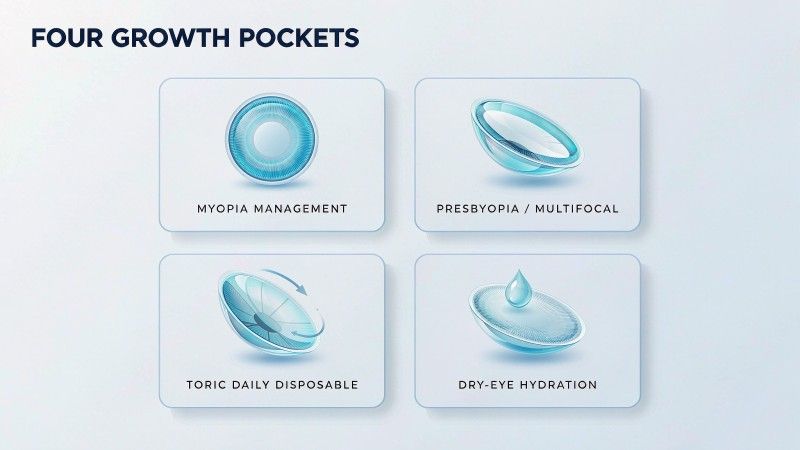
The Four Pockets at a Glance
| Growth pocket | Demand driver | Critical technical requirement | Supplier readiness signal | Regulatory load |
|---|---|---|---|---|
| Myopia management | Prevalence: ~50% of the world myopic by 2050 | Controlled peripheral defocus + high Dk + daily disposable | Design rationale, paediatric fitting range, clinic support material | High — prescription device, clinical claims |
| Presbyopia / multifocal | ~1.8bn presbyopes, peaking around 2030 | EDF optics, wide add range, adaptation guidance | Trial sets, fitting protocol, add-power steps | Medium — device registration per market |
| Toric daily disposable | Under-penetrated astigmatism, care-free format | Rotational stability + full axis/cyl coverage | 10° or 5° axis steps, kit configuration, MOQ per SKU | Medium — SKU-level registration discipline |
| Dry-eye-friendly hydration | Screen time, environment, drop-out | Wettable surface, low modulus, oxygen flow | Documented surface technology, substantiated claims | Medium–high — claim substantiation |
The Four Technologies That Decide Which Supplier Wins
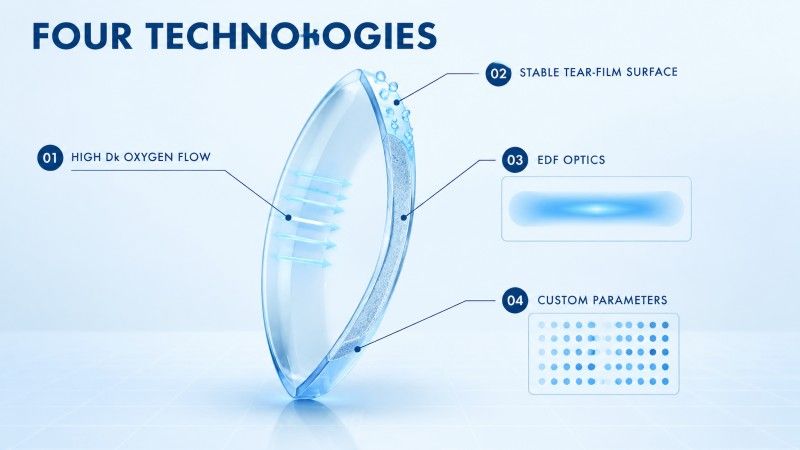
1. High Dk oxygen transmissibility
Silicone hydrogel materials now deliver roughly 100–160+ Dk/t where conventional hydrogels sit near 30 (clinical summary) — a difference that matters most in extended wear, in paediatric eyes, and in anyone whose corneas already show stress. But Dk is a material property, not a comfort guarantee. High-Dk silicone is inherently hydrophobic; how a manufacturer handles the surface determines whether that oxygen advantage arrives as comfort or as a dry, tacky lens.
2. Tear-film stabilising and antioxidant surface technology
The surface is where the next round of differentiation is being fought. Plasma treatment, zwitterionic coatings, and internal wetting agents all aim at the same outcome: a hydrophilic surface that holds a stable tear film and resists protein and lipid deposition through a full wearing day. Antioxidant surface concepts are emerging as a marketing frontier, and brands should treat them the way they treat any new claim — ask for the test method, not the adjective.
3. EDF optics
Extended depth of focus is the most consequential optical change in the category in a decade, because it converts a high-friction product into a fit-and-forget one for a large slice of presbyopes. The commercial implication is that multifocal ranges designed five years ago are now disadvantaged against EDF competitors on the same shelf, even at the same price point.
4. Customisation
Custom and semi-custom lenses — extended parameter ranges, high cylinders, irregular corneas, made-to-order tints — are lower volume and higher margin, and they create switching costs that commodity spheres never will. The trade-off is lead time and minimum order. A supplier who can run both a 1,500-design ready-ship catalogue and a custom lane is a different kind of partner from one who can only do one of the two.
The Compliance Side: Colour Lenses Are Now a Documentation Business
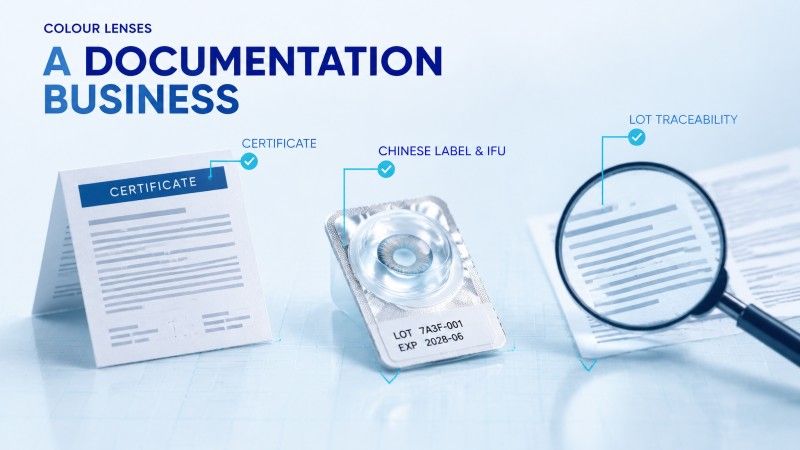
Everything above concerns prescription optics. The consumer-facing growth engine — colour and cosmetic lenses — sits under a different regime, and it is tightening.
China: Class III, registration first
Decorative colour plano contact lenses in China are managed as Class III medical devices, the highest risk category. They must pass safety and efficacy evaluation and hold a medical device registration certificate before they can be manufactured, sold, or imported (NMPA consumer guidance). NMPA has run dedicated enforcement campaigns covering production, distribution, online sales, and penalties (NMPA, 2022), and consumer warnings continued into 2025.
For a cross-border seller, this collapses into three artefact checks.
1. The registration certificate must match the product, not the category
A certificate is issued for a specific manufacturer, a specific product name and model, and a specific structure and material. Sellers routinely fail here by accepting a certificate that covers a similar lens, or a certificate issued to a trading entity rather than the manufacturing site. Check the certificate number, the registrant, the manufacturing address, the model designation, and the validity window against the exact SKU you intend to sell.
2. Chinese-language labelling is not a sticker you add later
Chinese medical device labelling and instruction requirements are set out in NMPA’s provisions on instructions and labels (Decree No. 6). The label content — device name, registration certificate number, manufacturer, model, batch, expiry, contraindications, and warnings — must be present in Chinese, on the product and in the instructions. Retrofitting a translated sticker in a warehouse is a common shortcut and a common enforcement finding.
3. Traceability has to survive an audit, not just a shipment
Batch and lot numbers must allow a lens sold at retail to be traced back to a production run and a manufacturer. That means the lot code on the blister, the carton, and the commercial invoice have to agree, and the importer or distributor must hold the operating licence that permits them to handle the device at all. Online sales add a further layer: platform filing and, in China, qualification review of the seller as a medical device operator.
The wider pattern
China is the strictest example, not the only one. The EU requires MDR conformity and EUDAMED registration; the US requires FDA clearance for colour lenses as devices; Saudi Arabia, Australia, Japan, and Brazil each run their own pathway. A range that is compliant in one market is not automatically sellable in another — the certificate, the label, and the language all change.
Compliance Checklist for Cross-Border Colour Lens Sellers
| Document | What to verify | Most common failure |
|---|---|---|
| Registration certificate | Number, registrant, manufacturing site, model, validity | Certificate covers a different model or a trading company |
| Chinese label & IFU | Full Chinese text, certificate number, warnings, contraindications | Sticker applied post-import; incomplete warnings |
| Traceability record | Lot code consistency across blister, carton, invoice | Lot codes do not reconcile; no manufacturing site on record |
| Business licence / operator qualification | Right to handle Class III devices in the selling market | Seller registered for general goods, not medical devices |
| Platform filing (online) | Seller qualification review completed | Listing goes live before review closes |
| Test / technical file | Material, tint, and biocompatibility documentation current | Technical file predates a material or supplier change |
What This Means for Your 2027 Range Plan
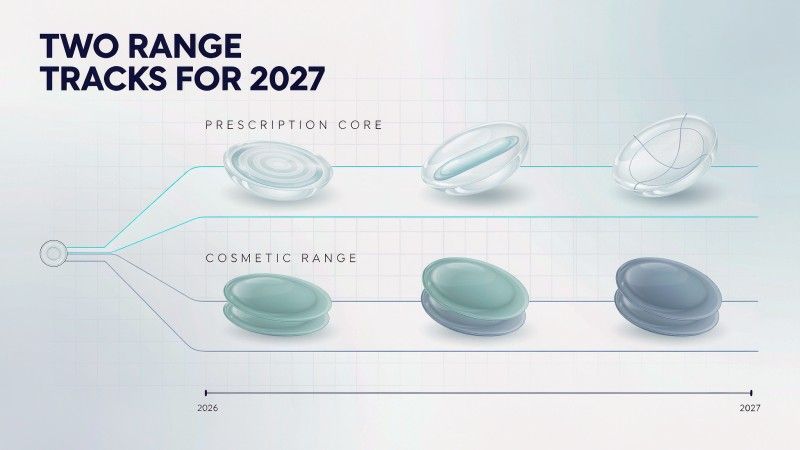
- Stop planning one range for one market. Plan a prescription core (myopia management, multifocal, toric daily) and a cosmetic range (colour, daily and monthly) with separate compliance tracks and separate suppliers if necessary. They are now governed by different logic.
- Ask for the certificate before you ask for the price. On colour lenses, the certificate is the product. A quotation without a matching registration document is not a quotation — it is a risk transfer.
- Treat toric as an inventory design problem. Choose axis steps and cylinder depth against your actual market’s prescription distribution, not against what is easiest to produce. Then negotiate kitting and MOQ per SKU before you commit to a range.
- Put an EDF product in the multifocal slot. If your multifocal line is more than three years old, it is now competing against EDF designs on the same shelf with the same consumer expectation. This is the cheapest upgrade in the category.
- Sell comfort with substantiated language, not therapeutic language. Hydration claims win shelf space; medical claims win regulatory letters. Keep the wording inside what your documentation supports.
- Build traceability into packaging, not into a spreadsheet. Lot-level reconciliation is an operational capability. If it only exists in an email thread with the factory, it will fail the first time a distributor is audited.
Where a Factory Partner Fits
Most of the decisions above are manufacturing decisions before they are marketing decisions: whether a material can hit a Dk target at a given modulus, whether an EDF design can be produced at your price point, whether a toric range can be kitted in the axis steps your market actually needs, and whether the documentation behind a colour lens is complete enough to register in the market you are entering.
Beautylens Technology Co., Ltd. operates as the global marketing and service headquarters of a family enterprise that began in 1984 with Gansu Constar Technology Group and expanded through Hunan Liangguo Group and Hunan Haipuming Technology. R&D, moulds, and quality control sit inside the same group — CE certified production with ISO 13485 quality control and batch traceability, and an FDA-registered facility (FEI 3015587162) for the US market, with documentation support for EUDAMED and SFDA registration.
For buyers building a 2027 range, three starting points are useful: the factory credentials behind the production claims, the ready-ship catalogue covering 1,500+ designs across daily, monthly and annual formats, and the brands we operate ourselves — MILLCREEK, KSSEYE, Duoxiu and Haipurecon — because running our own labels is the most honest test of whether an OEM process works.
FAQ
Is the contact lens market still growing overall?
Yes, but slower than its sub-segments. Third-party estimates put the total category at roughly 5–7% annual growth, while myopia control lenses are estimated above 16% and multifocals near 7%. The practical implication is that a generic sphere range grows with the market, while a well-chosen specialty range grows faster than it.
Which segment is growing fastest?
Myopia management. It combines a structural driver (rising prevalence), a clinical driver (progression control rather than correction), and a willingness to pay that is not price-sensitive in the way cosmetic lenses are.
What is the difference between a multifocal and an EDF lens?
A conventional multifocal splits light into separate distance and near zones, which produces high acuity at those two points but halos and a narrow intermediate range. EDF optics create one continuous elongated focal region, sacrificing a little peak sharpness for a smooth range from distance through intermediate to near.
Do colour contact lenses need a registration certificate in China?
Yes. Decorative colour plano lenses are Class III medical devices in China and require a registration certificate before manufacture, import, or sale. The certificate must cover the specific model and manufacturing site, not just the product category.
What labelling is required?
The label and instructions must be in Chinese and must include the device name, registration certificate number, manufacturer and manufacturing address, model, batch, expiry, contraindications, and warnings, consistent with NMPA’s provisions on medical device instructions and labels.
How do I verify a supplier’s certificate?
Match five fields against the exact SKU: certificate number, registrant, manufacturing address, model designation, and validity period. Then confirm the manufacturing site is the one that will actually produce your order — this is where trading intermediaries most often diverge from the documentation.
What Dk/t should I be looking for?
Silicone hydrogel materials commonly deliver 100–160+ Dk/t against roughly 30 for conventional hydrogels. Higher is generally better for corneal health, but it is not a proxy for comfort: surface treatment, modulus, and water content determine how the lens feels.
Can a factory support both a large ready-ship range and custom work?
Some can, and it is worth asking explicitly. A 1,500-design ready-ship catalogue with 7–10 day dispatch serves launch and reorder; a separate custom lane serves extended parameters and made-to-order tints. The two require different production planning, so confirm both exist before you design a range that depends on them.
Sources
- Holden BA et al., Global Prevalence of Myopia and High Myopia and Temporal Trends from 2000 through 2050, Ophthalmology — PubMed 26875007
- InsightAce Analytic, Myopia Control Lenses Market — report
- Dataintelo, Multifocal Contact Lenses Market — report
- GP Insights: Aspheric and EDOF Lenses for Presbyopia, Contact Lens Spectrum, Jan–Feb 2026 — article
- NMPA, consumer guidance on decorative colour plano contact lenses — nmpa.gov.cn
- NMPA, special campaign on regulating decorative colour contact lenses (2022) — nmpa.gov.cn
- NMPA, Provisions for Instructions and Labels of Medical Devices (Decree No. 6) — english.nmpa.gov.cn
- Twenty-five years of silicone hydrogel soft contact lenses, PMC review — PMC12184980
Beautylens Technology Co., Ltd. — Empowering Contact Lenses Brands Worldwide.