
What OEM and ODM Mean
The two acronyms describe who owns the design, not who owns the machine.
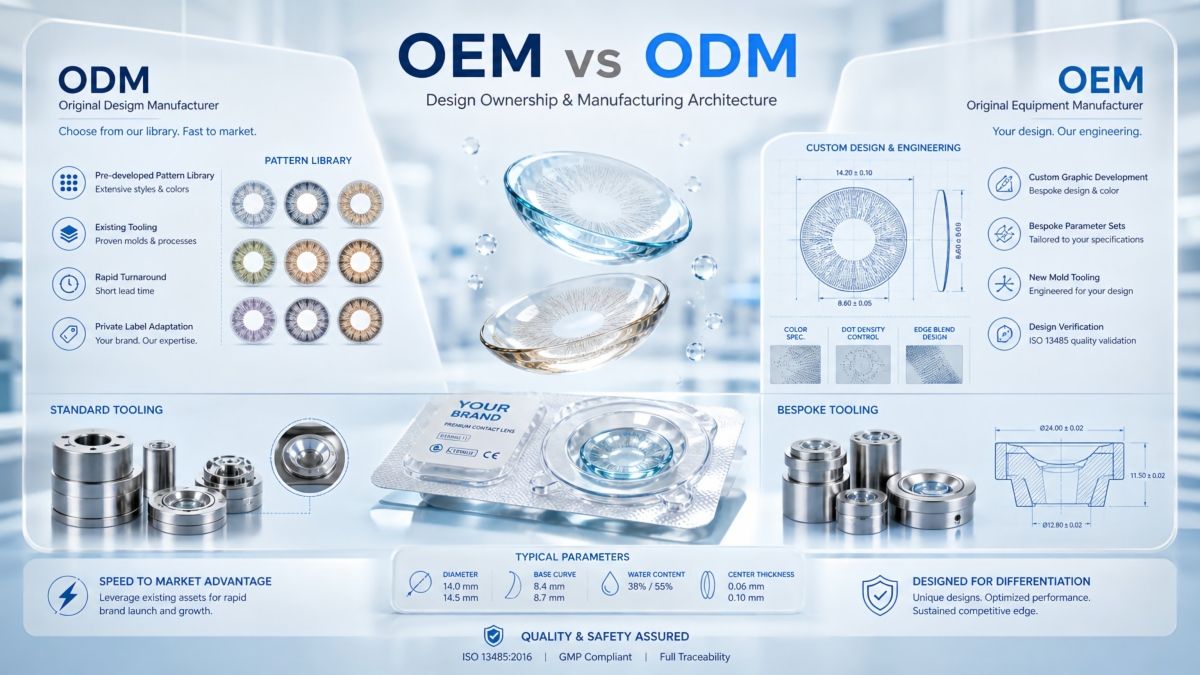
OEM — original equipment manufacturer. The buyer defines the product; the manufacturer builds to that specification. The graphic design, the parameter set and the packaging are specified by the buyer, and the finished lens carries the buyer’s brand. In practice the term is used loosely, and in consumer-goods contexts it is often used for any contract manufacturing arrangement.
ODM — original design manufacturer. The manufacturer owns the design. The buyer selects an existing design or pattern from the manufacturer’s development library and applies its own brand, packaging and market positioning. The underlying design does not change.
Private label is the branding model rather than the production model. It describes a product made for and sold under a retailer’s or brand owner’s own name. A private label programme can sit on either an ODM or an OEM arrangement, which is why the three terms are frequently used interchangeably — and why they should not be treated as interchangeable when the question is who owns the design and who holds the regulatory approval.
How the Two Models Differ
| ODM-based programme | OEM-based programme | |
|---|---|---|
| Design ownership | Manufacturer | Buyer, or buyer and manufacturer jointly |
| What the buyer selects | An existing pattern and parameter set | A specification to be developed |
| Typical tooling impact | Existing moulds and print plates, or a limited new set | New moulds or inserts, new print plates |
| Development work | Colour and packaging adaptation | Graphic development, sample iterations, design verification |
| Exclusivity | Rarely exclusive unless negotiated | Commonly exclusive to the buyer |
| Time to first production | Usually shorter | Usually longer |
The practical difference shows up in two places. First, in tooling: an ODM programme reuses tooling that already exists, whereas an OEM programme usually requires new tooling for a new graphic, and often for each parameter combination within it. Second, in verification: a design that already exists has an existing design verification history, while a new design needs its own.
How a Private Label Programme Works, Step by Step
The sequence below describes the mechanism common to most programmes; the depth of each step varies with the model and the product.
- Requirement definition. The product scope is fixed: lens type, material family, replacement schedule, parameter range (sphere, and where relevant toric or multifocal), graphic or colour range, packaging format and target markets. This step determines how many distinct stock-keeping units the programme will contain, which in turn drives almost everything downstream.
- Design selection or development. In an ODM programme, a pattern is selected from the existing library and adapted. In an OEM programme, the graphic is developed: iris pattern, colour blending, graphic diameter, limbal ring and any highlight element, usually iterated against sample prints.
- Tooling and print set-up. Mould inserts for each parameter combination and print plates for each graphic are produced. Tooling is the step that makes low volumes uneconomic, because it is a fixed cost that does not scale down with order size.
- Sample production and approval. Prototype lenses are produced and assessed for appearance, geometry and fit behaviour. Multiple iterations are normal, particularly for colour work, because a printed pattern reads differently on the eye than it does on a design file.
- Design verification and testing. The lens is tested against the applicable specification: geometry and optical parameters under the ISO 18369 series, biological evaluation under the ISO 10993 series, and stability and package integrity for the intended shelf life.
- Packaging and labelling design. Blister or vial format, printed foil or carton, labelling content and languages. Labelling requirements are set by the markets of sale, and this step frequently runs in parallel with regulatory work.
- Regulatory clearance or registration. Depending on the market and the classification of the device, this may mean a notified body review in the European Union, a premarket notification in the United States, or a national registration elsewhere. This is usually the longest and least predictable step in the programme.
- Production, release and delivery. Manufacturing under the applicable quality system, in-process and final inspection, lot release, and shipment.
What Determines Minimum Order Quantity
Minimum order quantity is usually presented as a commercial number, but it is the arithmetic result of fixed costs that do not shrink with the order.
- Tooling. Each distinct combination of lens design and parameter requires its own mould or mould insert. A programme offered across a range of powers, and in toric form across cylinder and axis values, multiplies the number of parts required before a single lens is sold.
- Print set-up. Each graphic requires its own print plate or engraved cylinder. A new colourway means a new set-up even when the lens geometry is unchanged.
- Production run economics. Moulding, curing and hydration steps have a practical minimum run before set-up time and material losses are recovered. Changeover between graphics or parameters consumes line time either way.
- Batch processing. Sterilization is carried out in validated batches, and batch size has a floor. A small order still occupies a batch.
- Packaging print runs. Printed foil and cartons have their own minimum print quantities, which can exceed the minimum for the lenses themselves.
- Quality control sampling. Inspection and testing are performed on defined sample sizes per batch, so the testing burden per unit falls as batch size rises.
- Design verification. A genuinely new design carries verification work that a reused design does not.
The structural point is that MOQ is driven by the number of distinct items in a programme rather than by its total volume. Ten thousand lenses in one colourway and ten thousand lenses spread across fifty colourways have very different cost structures, even though the unit count is the same.
Packaging and Labelling in Private Label Programmes
Packaging in a private label programme is not only a design exercise. Three constraints interact:
- Format. Blister packs and glass vials impose different requirements on the manufacturer’s filling and sealing line, and not every format is available for every product.
- Sterile barrier. The package is the sterile barrier. Changes to materials or to the sealing process are changes to the device’s packaging system and are covered by the same validation and stability work as the lens.
- Labelling content. What must appear on the label, in which languages, and in what format is set by the market of sale. Information that is mandatory in one market may be absent from the requirements of another, and the same physical pack cannot always serve both.
For an own-brand product, the label carries the brand owner’s name and the regulatory identifiers that belong to the brand owner, not the manufacturer’s.
Regulatory Responsibility: Brand Owner and Manufacturer
This is the part of a private label programme that carries the most consequence, and it is frequently underestimated.
European Union. Under Regulation (EU) 2017/745, the manufacturer is the person who manufactures the device, or has it designed or manufactured, and markets it under their own name or trademark. A brand owner that puts a lens on the EU market under its own brand is therefore a manufacturer, with the obligations that follow: a quality management system, technical documentation, conformity assessment through a notified body for the applicable class, a Unique Device Identifier, post-market surveillance, and vigilance reporting. Where the brand owner is established outside the EU, an authorised representative is required. Contracting production to a supplier does not transfer these obligations; the own-brand manufacturer remains responsible for the activity carried out on its behalf.
Coloured, non-corrective contact lenses that have no corrective function are treated as products without an intended medical purpose and are regulated through Annex XVI of the MDR, with common specifications set out in Commission Implementing Regulation (EU) 2022/2346 and qualification and classification guidance in MDCG 2023-5. That means the same ownership of responsibility applies to a purely cosmetic lens.
United States. Contact lenses are Class II or Class III devices depending on the material and the wearing schedule, and the route to market is generally a premarket notification unless the device falls within an already cleared family. The entity that markets the device under its own name is responsible for the clearance that covers the product as labelled, for establishment registration and device listing, and for the labelling and instructions for use. A supplier’s clearance does not automatically extend to a different brand, a different graphic or different labelling.
The practical implication is that in most private label programmes the manufacturer of record is the brand owner, and the production facility is a supplier operating under the brand owner’s quality system. The brand owner’s name appears on the label because the responsibility is theirs.
Scope note. This article explains how these models are structured. Which supplier, pattern or programme suits a particular commercial project is a sourcing question rather than an industry-knowledge question, and it is outside the scope of this platform.
Typical Project Timeline
Timelines vary widely with the number of stock-keeping units, whether new tooling is required, and the market of sale. What is consistent is the shape of the critical path:
| Phase | What governs the duration |
|---|---|
| Requirement definition | Buyer-side decisions; the fastest phase to control |
| Design and sampling | Number of iterations; colour work is iterative by nature |
| Tooling | Number of distinct parts; fixed and front-loaded |
| Verification and testing | Test scope and laboratory scheduling |
| Regulatory clearance | Market, classification and whether a notified body or regulator must review the device — usually the longest and least predictable element |
| Production | Order size relative to batch and run minima |
The recurring mistake in planning is to start the clock at production. In practice, tooling and regulatory clearance sit ahead of the first saleable batch, and neither compresses simply by ordering more lenses.
Common Misunderstandings
“OEM and ODM are the same thing.” They describe different ownership of the design. That difference determines tooling cost, exclusivity and the length of the development phase.
“Private label means the manufacturer’s name goes on the pack.” For an own-brand product the label carries the brand owner’s identity and the regulatory identifiers attached to it, because the brand owner is the manufacturer of record.
“A supplier’s certificate covers my product.” A certificate covers the device it was issued for. A different brand, graphic, material or labelling is a different device as far as the approval is concerned.
“A minimum order quantity is a negotiating position.” It is largely a cost recovery figure built from tooling, print set-up, batch minima and inspection sampling. Negotiation can move it; it is not arbitrary to begin with.
“More colourways means more choice at the same cost.” Each colourway adds print set-up and inventory complexity, and in many markets its own verification and labelling work. Breadth is a cost decision as much as a marketing one.
“The design is the difficult part.” Design iterations are visible and controllable. Regulatory clearance is the step that most often determines when a product can actually be sold.
FAQ
Can a brand start with one colour and add more later? Yes, and that is the common sequence, because each additional colourway carries its own print set-up and its own labelling and approval implications in most markets.
Who owns the mould in an OEM programme? Ownership is a contractual matter and is not determined by the model. In practice it is one of the terms that decides whether a design can be used by anyone other than the buyer.
Does a private label lens have to be a different product from the manufacturer’s own brand? Not necessarily. An ODM programme can place entirely different branding on a design that also exists elsewhere. Where exclusivity matters, it has to be negotiated and reflected in tooling ownership.
Is a notified body required for coloured non-corrective lenses in the EU? Non-corrective contact lenses fall under Annex XVI of the MDR and are subject to the common specifications in Implementing Regulation (EU) 2022/2346, with classification guidance in MDCG 2023-5. Whether notified body involvement is required depends on the classification that applies to the specific device. The current position should always be confirmed with the notified body or against the Commission’s published guidance.
Why does the same lens cost more in a small order? Because fixed costs — tooling, print set-up, batch minima, inspection sampling, packaging print runs — are divided across fewer units.
Can a brand sell in the EU without an EU establishment? A manufacturer established outside the EU needs an authorised representative in the EU. The obligation attaches to the manufacturer, and appointing a representative does not transfer it.
Does a new graphic require a new approval? It requires assessment against the existing approval. Where the graphic changes the device as marketed, a separate clearance or a variation to the technical documentation is generally needed.
What is the most common cause of delay? Underestimating the regulatory phase. Design and sampling delays are visible and can be iterated quickly; regulatory review sits outside the project’s control.
Related Terms
OEM · ODM · private label · white label · tooling · print plate · minimum order quantity · design verification · conformity assessment · notified body · authorised representative · manufacturer of record · Unique Device Identifier · UDI-DI · Annex XVI
Sources and References
Regulation and guidance
- Regulation (EU) 2017/745 on medical devices (MDR) — in particular Article 2(30) (definition of manufacturer), Article 10 (obligations of manufacturers) and Article 16 (own-name placing on the market)
- Commission Implementing Regulation (EU) 2022/2346 — common specifications for products without an intended medical purpose listed in Annex XVI
- MDCG 2023-5, Guidance on qualification and classification of Annex XVI products — https://health.ec.europa.eu/document/download/ea4acf26-979a-4dbb-92ff-8d1d804da51a_en?filename=mdcg_2023-5_en.pdf
- MDCG 2023-6, Guidance on demonstration of equivalence for Annex XVI products
- MDCG endorsed documents and other guidance, European Commission — https://health.ec.europa.eu/medical-devices-sector/new-regulations/guidance-mdcg-endorsed-documents-and-other-guidance_en
- US 21 CFR Part 807 — establishment registration and device listing; US 21 CFR 886.5925 — Soft (hydrophilic) contact lens
Standards (cited by designation; available from ISO and national standards bodies)
- ISO 18369-1 to ISO 18369-4, Ophthalmic optics — Contact lenses
- ISO 10993-1, Biological evaluation of medical devices — Part 1: Evaluation and testing within a risk management process
- ISO 13485, Medical devices — Quality management systems — Requirements for regulatory purposes