 kangshida
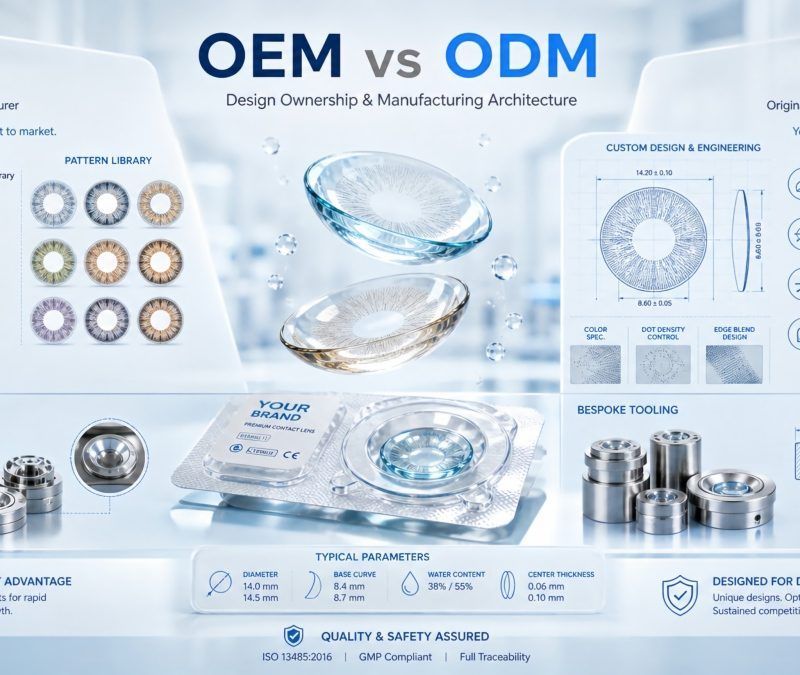
The short answer: in colored contact lenses, OEM, ODM and private label are not three price tiers of the same product — they describe who owns the design, who pays for the mould, and whose name sits on the technical file. Private label means you take a design that already exists and put your brand on it. OEM means you bring the colour, geometry or packaging specification and the factory builds to your drawing. ODM means the factory develops the product and you brand it. Everything buyers experience as “cost” and “lead time” is downstream of one variable: how far your design deviates from a mould that already exists.
The three models, defined precisely
The industry uses these words loosely. Suppliers call catalogue products “OEM” because it sounds more technical, and buyers sign contracts believing they own a design that the factory is also selling to three competitors. Precision here is worth money, so start with the definitions.
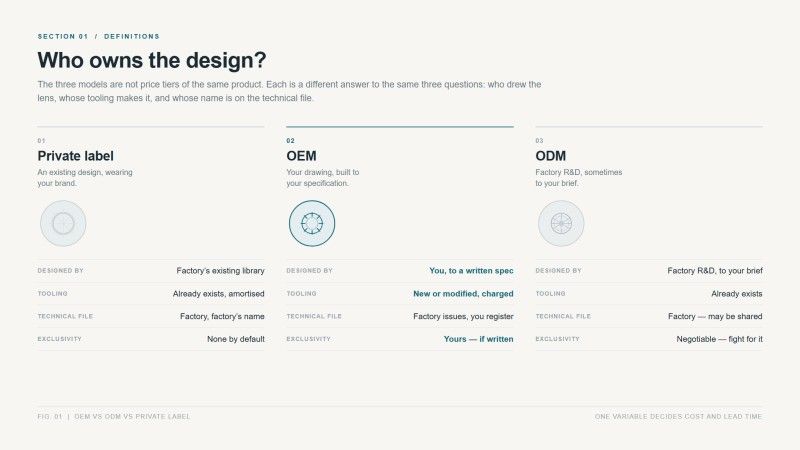
| Private label | OEM | ODM | |
|---|---|---|---|
| Who designs the lens | Factory’s existing design library | You (or your designer), to a written spec | Factory’s R&D, sometimes to your brief |
| What you customise | Brand, packaging, labelling, selection | Colour, pattern, geometry, water content, packaging | Brand and packaging on a factory-developed product; sometimes exclusive territory |
| Mould and tooling | Already exists and is already amortised | New or modified tooling, usually charged or amortised into the first order | Already exists |
| Who holds the technical file | Factory, in the factory’s name | Factory issues it; you hold your market registration | Factory, and it may be shared across several brands |
| MOQ driver | Minimum run per SKU and per packaging print | Tooling amortisation plus minimum run | Minimum run per SKU |
| Typical first-order time | Weeks, not months | Months, because of tooling | Weeks to a few months |
| Design exclusivity | None by default | Yours, if the contract says so | Negotiable — and this is the term to fight for |
The distinction that matters commercially: private label and ODM put you on a product other brands can also buy. OEM is the only model where the mould, the colour formulation and the drawing are specific to you — which is why it costs more up front and less per unit at volume.
Where the money actually goes
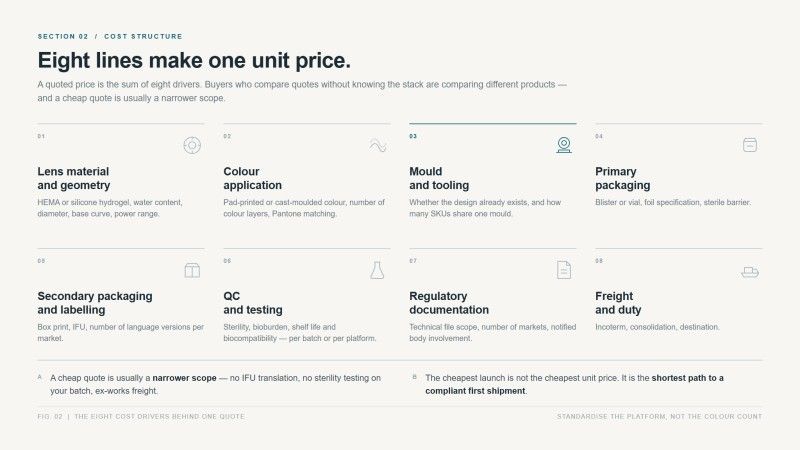
A quoted unit price for a colored contact lens is the sum of eight cost drivers. Buyers who compare quotes without knowing the stack end up comparing different products.
| Cost driver | What moves it | How a buyer reduces it |
|---|---|---|
| Lens material and geometry | HEMA vs silicone hydrogel, water content, diameter, base curve, power range | Standardise on one platform instead of four |
| Colour application | Pad-printed vs cast-moulded colour, number of colour layers, Pantone matching | Cut the number of shades per order; approve a master swatch once |
| Mould and tooling | Whether the design exists; number of SKUs sharing a mould | Start from the existing design library, customise later |
| Primary packaging | Blister vs vial, foil specification, sterile barrier | Keep one packaging format across the range |
| Secondary packaging and labelling | Box print, IFU, number of language versions | One language run per market, not per SKU |
| QC and testing | Sterility, bioburden, shelf-life and biocompatibility testing per batch or per platform | Test per platform, not per colour |
| Regulatory documentation | Technical file scope, number of markets, notified body involvement | Reuse one technical file across SKUs on the same platform |
| Freight and duty | Incoterm, consolidation, destination | Consolidate SKUs into one shipment; agree the Incoterm in writing |
Two consequences follow. First, a cheap quote is usually a narrower scope — no IFU translation, no sterility testing on your batch, ex-works freight. Second, the cheapest way to launch is not the cheapest unit price; it is the shortest path to a compliant first shipment.
MOQ is a tooling number, not a scale number
Buyers routinely assume MOQ exists because factories want large orders. It exists because of four physical minimums:
- Mould amortisation — a new design needs its own tooling. That cost is recovered across the first production runs, so a custom design carries a floor that a catalogue design does not.
- Minimum run per SKU — production lines run per design, per power range. Splitting one order across twelve shades multiplies setup time.
- Pigment batch minimum — colour is mixed in batches. A shade used for 300 pairs still consumes a batch.
- Packaging print minimum — printed boxes and IFUs have their own minimum, often higher than the lens MOQ itself.
This is why the honest answer to “what is your MOQ” is always two numbers: one for designs already in production, one for a new design. At Beautylens, stock designs ship from a library of 1,500+ ready-ship SKUs across daily, monthly and annual lenses, which is what allows a first order in the hundreds of pairs rather than the tens of thousands. A brand-new mould does not have that flexibility, and no supplier honestly can.
Timeline: what the calendar is really made of
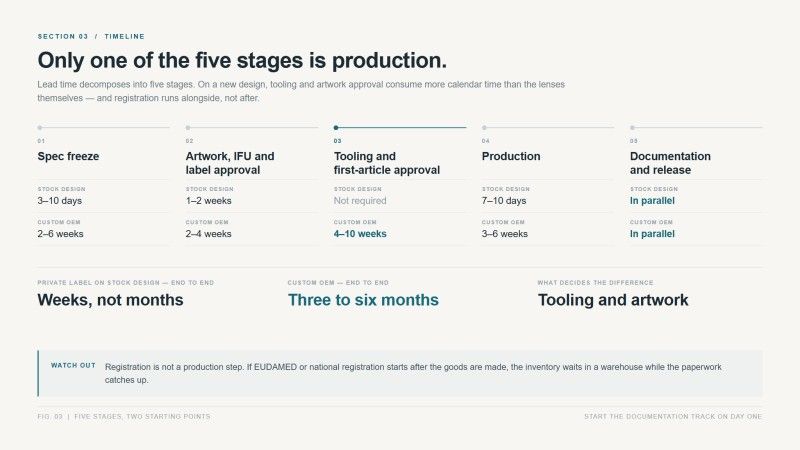
Lead time is not one number either. It decomposes into five stages, and only one of them is production.
| Stage | Private label on stock design | Custom OEM |
|---|---|---|
| Spec freeze (colour, geometry, packaging) | 3–10 days | 2–6 weeks |
| Artwork, IFU and label approval | 1–2 weeks | 2–4 weeks |
| Tooling and first-article approval | Not required | 4–10 weeks |
| Production | 7–10 days from China on ready-ship designs | 3–6 weeks per run |
| Documentation and release | Runs in parallel | Runs in parallel |
Two observations from real projects:
- Production is rarely the bottleneck. Artwork, IFU language versions and first-article colour approval consume more calendar time than the lenses do.
- Registration is not a production step. If EUDAMED or national registration starts after the goods are made, the inventory waits in a warehouse while the paperwork catches up. Start the documentation track on day one, not after the purchase order.
Three costs that never appear on a quotation
These are the ones that turn a well-priced project into an expensive one.
1. The colour that doesn’t match the master swatch. A shade approved on a screen is not a shade approved on a lens. Batch-to-batch variation in pigment and curing shows up as a visible difference under retail lighting, and re-running a batch is a full production cycle. Approve a physical master swatch, signed by both sides, before the bulk run — not a PDF.
2. Packaging that fails at the border. Labels missing the manufacturer identification, the prescription statement or the required language version do not get “fixed later” — they get held. In the EU, labelling and instructions for use must be in the language(s) required by the member state of destination; in the US, all contact lenses, including decorative ones, are prescription devices. This is a design decision made at artwork approval, not a shipping problem.
3. The design you don’t own. If the contract does not say who owns the drawing, the mould and the colour formulation, then in practice the factory does — and can offer the same lens to your competitor. Ownership, exclusivity period and territory belong in writing before the first sample, not after the first successful season.
Which model fits which stage
| Your situation | Sensible model | Why |
|---|---|---|
| Testing a niche, first order under ~5,000 pairs | Private label on a stock design | No tooling spend; fastest route to a compliant first shipment |
| Proven sell-through, want one signature shade | OEM on an existing platform | One mould, one colour, controlled cost |
| Multi-market brand with its own packaging system | OEM or ODM with territory terms | Consistency across SKUs and markets matters more than unit price |
| Distributor wanting market exclusivity | ODM with a written exclusivity clause | Exclusivity is a contract term, not a product feature |
| First-time brand owner with no product team | ODM plus a compliance partner | You are buying development capability, not just capacity |
Six questions to ask on the first call
The answers separate a factory from a reseller faster than any brochure.
- “Which specific mould will produce my lens, and does it exist today?” A factory answers with a mould reference. A reseller changes the subject.
- “Who signs the technical file, and in whose name?” It must be the legal manufacturer. If the answer is vague, your registration will be too.
- “What is the MOQ for a stock design versus a new design?” Two numbers, or the supplier is quoting you a catalogue price with custom language.
- “Which language versions of the IFU can you supply, and who pays for translation?” This is where first shipments die.
- “Can you show batch traceability from raw material to finished blister?” Ask for one lot record, redacted. It is a five-minute request for a real manufacturer.
- “If the first batch colour deviates, what is the rework policy?” Get the tolerance and the remedy in the contract.
The compliance baseline to verify before you compare prices
Every quotation you receive should be read against the same baseline, because a supplier who cannot meet it is not cheaper — the cost simply moves to you.
- ISO 13485 quality management system, audited, with a certificate number you can check.
- CE marking under MDR (EU 2017/745) where the EU is a target market — and confirmation that it is MDR, not the pre-2021 MDD.
- FDA establishment registration where the US is a target market — note the precise wording: a registered facility is not the same as a cleared product, and both matter for different reasons.
- Batch traceability covering raw material, production lot and release.
As a reference point for what this looks like in practice: Beautylens Technology Co., Ltd. is the international marketing and service headquarters of a family manufacturing group that began in 1984 with Gansu Constar Technology Group. Production is CE-marked to MDR (EU 2017/745) with ISO 13485 quality control and full batch traceability, plus an FDA-registered facility (FEI 3015587162) for the US market, and the group launches 100+ new designs a year with Pantone-validated colour matching. Those are the claims worth asking any supplier to evidence on paper.
FAQ
- Is OEM the same as private label?
No, although the market uses them interchangeably. Private label applies your brand to a design that already exists. OEM builds a product to a specification you own. The difference shows up in tooling cost, unit price at volume, and whether a competitor can buy the same lens.
- What is a realistic MOQ for colored contact lenses?
Stock designs can start in the hundreds of pairs because the tooling is already amortised. A new design carries a materially higher floor, because a mould, a colour formulation and a packaging print run all have their own minimums. Always request both figures before comparing suppliers.
- Do I own the mould if I pay for it?
Only if the contract says so. Paying a tooling charge does not automatically transfer ownership or exclusivity. Ask for a written clause covering mould ownership, design ownership and the period during which the factory will not supply the design to others.
- How long does a first order take?
For a stock design with compliant packaging, weeks rather than months — ready-ship designs can leave China in 7–10 days once artwork is approved. A fully custom design typically runs three to six months, dominated by tooling and documentation rather than production.
- Can I get an exact Pantone colour match?
You can get a validated match against a physical master swatch, which is the only standard that survives production. Ask for the swatch to be signed by both parties and referenced in the purchase order, along with the acceptable tolerance and the rework remedy.
- Who is responsible for regulatory registration in my market?
The manufacturer issues the technical documentation; the party placing the device on the market holds the registration. Clarify in writing who prepares the file, who pays for translation and notified-body work, and what happens if registration is delayed after production.
- Is a trading company always a worse choice?
Not automatically — but the economics and the risk profile differ. A trading company adds a margin layer and usually cannot show you the mould or the lot records, and design confidentiality is harder to guarantee. If you use one, verify who the legal manufacturer is on the label.
- What should I approve before the bulk run?
Four things: a physical colour master swatch, the final artwork and IFU in the destination language, the first-article lens from the actual production mould, and the batch test plan. Approving any of these after production starts converts a scheduling problem into a write-off.